


إن مبرد الزيت الهيدروليكي that effectively prevents overheating is not simply the largest or most expensive option—it is the one properly matched to your system’s heat load, oil flow rate, pressure requirements, and operating conditions. For many industrial machines and mobile equipment, an aluminum-core air-cooled hydraulic oil cooler provides an ideal balance of efficient heat dissipation, compact design, durability, and low maintenance.
Why Do Hydraulic Systems Overheat and How Can a Hydraulic Oil Cooler Help?
Every hydraulic system generates heat during operation. This heat is produced by energy losses caused by fluid friction, pump and motor inefficiencies, and pressure drops as hydraulic oil passes through valves, hoses, and fittings. Even high-efficiency hydraulic pumps cannot convert all input energy into useful mechanical output, meaning a portion of the energy is inevitably released as heat.
When hydraulic oil temperature rises beyond the recommended operating range, usually around 50–60°C depending on the oil type and system design, hydraulic performance can gradually decline. Excessive heat reduces oil viscosity, increases internal leakage, weakens lubrication performance, and accelerates wear on critical components such as pumps, valves, and seals.
Continuous overheating may result in:
- Reduced hydraulic pump and motor service life
- Premature seal deterioration and oil leakage
- Formation of sludge and varnish deposits inside valves and filters
- Lower equipment reliability and increased maintenance costs
- Unexpected production downtime
For this reason, maintaining stable hydraulic oil temperature is essential for industrial machinery and mobile equipment. A properly selected hydraulic oil cooler helps remove excess heat, maintain oil properties, and protect the hydraulic system during continuous operation.
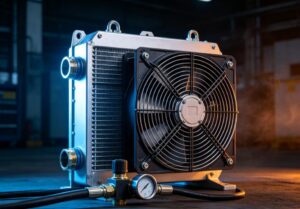
Key Factors to Consider When Choosing a Hydraulic Oil Cooler
Not all hydraulic oil coolers are designed for the same operating conditions. A reliable hydraulic cooling solution depends on more than cooling capacity alone. Core material, heat transfer design, working pressure, airflow efficiency, and installation environment all influence whether a cooler can effectively control hydraulic oil temperature over long-term operation.
Aluminum Core: A Lightweight Solution for Efficient Heat Dissipation
The core is one of the most important components of a hydraulic oil cooler because it directly affects heat transfer performance. Aluminum is widely used in air-cooled hydraulic oil coolers due to its excellent balance of thermal conductivity, weight, corrosion resistance, and manufacturing flexibility.
With a thermal conductivity of approximately 205 W/m·K, aluminum provides efficient heat transfer while allowing manufacturers to produce compact and lightweight cooler designs. Compared with heavier metal alternatives, aluminum hydraulic oil coolers are easier to install in equipment with limited space, making them suitable for applications such as excavators, construction machinery, and mobile hydraulic systems.
Aluminum also provides good corrosion resistance when properly treated with protective coatings or surface finishes. This makes aluminum-core hydraulic oil coolers a practical choice for equipment exposed to moisture, dust, outdoor conditions, or demanding industrial environments.
Brazed Fins and Optimized Airflow Design
The fin structure plays a critical role in determining the cooling performance of an air-cooled hydraulic oil cooler. Corrugated fins increase the heat exchange surface area, while louvered fin designs improve air turbulence and promote more efficient heat transfer between the oil cooler core and surrounding air.
However, cooling performance is not determined by fin density alone. Engineers must also consider airflow resistance, fan performance, fin spacing, and operating environment. For example, equipment working in dusty construction sites may require a fin design that balances heat dissipation with easier cleaning and maintenance.
A well-designed fin pack helps maintain stable cooling performance while reducing the risk of overheating caused by restricted airflow.
Working Pressure and Temperature Range: Matching Real Operating Conditions
A hydraulic oil cooler must be selected according to the actual conditions of the hydraulic system, including operating pressure, oil temperature, and environmental factors. For many industrial and mobile hydraulic applications, coolers are designed to withstand working pressures around 26 bar (approximately 377 PSI) and operating temperatures ranging from -20°C to 100°C, although specifications vary depending on the cooler design and manufacturer.
Choosing a hydraulic oil cooler with the appropriate pressure rating and temperature capability helps ensure reliable operation during pressure fluctuations, continuous workloads, and changing outdoor conditions.
Air-Cooled vs. Water-Cooled Hydraulic Oil Coolers: Which Option Is Right for Your Application?
Choosing between an air-cooled and water-cooled hydraulic oil cooler depends on several factors, including heat load, installation conditions, available cooling resources, and operating environment. Both cooling methods can effectively control hydraulic oil temperature, but they are designed for different application requirements.
Air-Cooled Hydraulic Oil Coolers: A Reliable Choice for Mobile Equipment
An air-cooled hydraulic oil cooler removes heat by using ambient air, a fan, and a finned aluminum core to transfer heat away from hydraulic oil. Because it does not require a separate water supply, pump, or cooling system, it offers simpler installation and easier maintenance.
For mobile equipment such as excavators, mini excavators, loaders, and compact construction machinery, air-cooled hydraulic oil coolers are often preferred because these machines frequently operate in remote locations where water-based cooling systems are impractical.
المزايا:
- No external water supply, pump, or cooling tower required
- Simple installation and lower maintenance requirements
- No risk of oil-water contamination
- Suitable for mobile equipment and outdoor applications
- Compact and lightweight design for space-limited installations
Considerations:
- Cooling performance may decrease in extremely high ambient temperatures
- Dust, mud, and debris can reduce airflow if fins are not cleaned regularly
- Fan operation creates additional noise and consumes electrical power
Water-Cooled Hydraulic Oil Coolers: Higher Cooling Capacity for Industrial Systems
A water-cooled hydraulic oil cooler uses a water-oil heat exchanger to transfer heat from hydraulic fluid into a separate cooling water circuit. Compared with air-cooled designs, water-cooled systems can achieve higher heat rejection capacity in a more compact structure.
They are commonly used in stationary industrial applications where continuous operation, high heat loads, and stable temperature control are critical, such as hydraulic presses, manufacturing equipment, and large industrial systems.
المزايا:
- Higher heat dissipation capacity for demanding applications
- More stable cooling performance regardless of ambient air temperature
- Smaller footprint for the same cooling capacity
- Suitable for high-temperature or dusty environments where air cooler fins may become contaminated
Considerations:
- Requires a reliable water supply and circulation system
- Additional costs for water treatment, pumping, and maintenance
- Potential risk of oil-water contamination if internal leakage occurs
- More complex installation compared with air-cooled hydraulic oil coolers
Comparison Table: Air-Cooled vs. Water-Cooled Hydraulic Oil Coolers
| الميزة | Air-Cooled Hydraulic Oil Cooler | Water-Cooled Hydraulic Oil Cooler |
|---|---|---|
| Cooling medium | Ambient air | Water or water-glycol mixture |
| Heat transfer efficiency | معتدل | High (approximately 4x the thermal capacity of air) |
| Ambient temperature dependence | High—performance drops in hot environments | Negligible—stable performance |
| Initial cost | Lower—simpler design, no external plumbing | Higher—requires water source and circulation system |
| Operating cost | Electricity for the fan | Water pumping and treatment |
| الصيانة | Clean fins regularly | Monitor water quality, prevent fouling |
| Risk of contamination | None | Oil-water mixing if rupture occurs |
| Best application | Mobile equipment, remote sites, retrofit | Stationary industrial, high heat load, hot environments |
The Verdict
For most industrial and mobile applications, an air-cooled hydraulic oil cooler with an aluminum core offers the best combination of reliability, cost-effectiveness, and ease of maintenance. Water-cooled makes sense when you have a reliable water supply, high ambient temperatures, or space constraints that favor a more compact design.
Real-World Applications: How Hydraulic Oil Coolers Improve Equipment Reliability
Understanding how hydraulic oil coolers perform in actual working environments is essential when selecting the right cooling solution. Different machines generate different heat loads, operate under different conditions, and require specific cooler designs to maintain stable hydraulic oil temperatures.
CNC Machine Tools: Maintaining Precision Through Temperature Control
CNC machine tools require consistent temperature control because hydraulic oil temperature fluctuations can affect fluid viscosity, machine positioning accuracy, feed stability, and machining quality. During continuous machining operations, a properly selected air-cooled or water-cooled hydraulic oil cooler helps maintain stable hydraulic conditions and supports reliable equipment performance.
For CNC applications, factors such as cooling capacity, temperature stability, vibration resistance, and installation space should be considered during hydraulic oil cooler selection. Maintaining proper oil temperature helps reduce thermal variation and supports consistent machining results during long production cycles.
Mini Excavators and Compact Construction Equipment: Compact Cooling for Space-Limited Applications
Mini excavators and compact construction machinery often have limited installation space, making compact and lightweight cooling solutions essential. An aluminum-core hydraulic oil cooler provides efficient heat dissipation while reducing overall equipment weight, making it suitable for mobile hydraulic systems where space and airflow conditions are restricted.
Because excavators and construction equipment operate outdoors, hydraulic oil coolers must also withstand changing environmental conditions, including dust, mud, vibration, and temperature fluctuations. Regular fin cleaning and proper airflow management are important to maintain cooling performance during demanding field operations.
Industrial HVAC Systems with Hydraulic Circuits: Supporting Continuous Operation
Industrial HVAC systems that use hydraulic circuits can generate significant heat during continuous operation. A properly sized hydraulic oil cooler helps remove excess heat, maintain hydraulic fluid performance, and reduce stress on connected components.
For facilities operating around the clock, selecting an appropriate hydraulic cooling solution can improve system reliability and reduce heat-related maintenance issues. Water-cooled hydraulic oil coolers are often considered for large stationary systems where high heat rejection capacity and stable temperature control are priorities.
How to Size a Hydraulic Oil Cooler Correctly for Your System
Selecting the correct hydraulic oil cooler size is critical for preventing overheating and maintaining reliable hydraulic system performance. A larger cooler does not always provide better results. An oversized hydraulic oil cooler may increase pressure drop, require unnecessary installation space, and add cost, while an undersized cooler may fail to remove enough heat during continuous operation.
The right cooler size depends on several factors, including hydraulic system heat load, oil flow rate, allowable pressure drop, operating temperature, and installation conditions.
Start with System Requirements, Not the Product Catalog
Before selecting a hydraulic oil cooler model, engineers should evaluate the actual operating conditions of the hydraulic system rather than choosing a cooler based only on equipment size or catalog specifications.
Consider these key questions:
- How much heat does the hydraulic system generate during actual operation?
The required cooling capacity should be based on the real working cycle, not only the rated horsepower of the equipment. - What is the hydraulic oil flow rate through the cooler?
Oil flow directly affects heat transfer performance and determines whether the cooler can handle the required thermal load. - What pressure drop can the hydraulic circuit tolerate?
Every hydraulic oil cooler creates some flow resistance, so the pressure drop must remain within the acceptable range of the return line or bypass circuit. - Are airflow conditions suitable for an air-cooled hydraulic oil cooler?
Fan performance, installation location, ambient temperature, and airflow availability all influence cooling efficiency. - Has the hydraulic system operating condition changed?
New attachments, longer operating hours, pump upgrades, or changes in workload can increase heat generation and may require a different cooling solution.
Calculate Hydraulic Oil Cooler Heat Load
A practical method for estimating cooling requirements is to consider that a portion of the hydraulic system’s input power is converted into heat during operation. In many hydraulic applications, approximately 25–30% of input horsepower may need to be dissipated as heat, depending on system efficiency and workload.
For example, a 50 HP hydraulic system may generate approximately 12.5–15 HP (around 9.3–11.2 kW) of heat that requires removal through a hydraulic oil cooler.
For accurate hydraulic oil cooler selection, engineers typically evaluate:
- Hydraulic oil flow rate
- Required cooling capacity or target outlet temperature
- Allowable pressure drop
- Oil viscosity
- Oil inlet temperature
- Ambient temperature for air-cooled systems
- Cooling water inlet temperature for water-cooled systems
Matching these parameters helps ensure the selected hydraulic oil cooler provides sufficient heat rejection without creating unnecessary system restrictions.
Pressure Drop: An Important Factor Often Overlooked
Pressure drop is one of the most important factors when selecting a hydraulic oil cooler, especially for return-line cooling applications. Every cooler introduces some resistance as hydraulic oil passes through the core.
If the pressure drop exceeds the hydraulic circuit’s tolerance, it can create excessive back pressure, reduce system efficiency, and potentially contribute to abnormal operating temperatures.
For this reason, the cooler’s pressure drop should always be checked at the actual operating flow rate before installation. A properly sized hydraulic oil cooler should balance heat dissipation performance with acceptable flow resistance.
Sizing Comparison: Common Applications
| التطبيق | Typical Heat Load | Recommended Cooler Type | Key Sizing Factor |
|---|---|---|---|
| Mini excavator (3–5 ton) | 5–10 kW | Air-cooled, aluminum core | Compact footprint, low pressure drop |
| CNC machining center | 3–8 kW | Air or water-cooled | Precise temperature control, low vibration |
| Industrial hydraulic press | 15–30 kW | Water-cooled preferred | High heat rejection, stable ambient |
| Mobile crane | 10–20 kW | Air-cooled | Rugged construction, vibration resistance |
| Marine hydraulic system | 5–15 kW | Water-cooled (seawater) | Corrosion-resistant materials |
Maintenance: Keep Your Hydraulic Oil Cooler Performing Efficiently
Even a high-quality hydraulic oil cooler cannot prevent overheating without proper maintenance. Regular inspection and cleaning help maintain heat transfer efficiency, extend cooler service life, and protect the hydraulic system from heat-related failures.
Clean the Fins Regularly
For air-cooled hydraulic oil coolers, fin contamination is one of the most common causes of reduced cooling performance. Dust, mud, fibers, oil mist, and jobsite debris can accumulate on the aluminum core surface, restricting airflow and reducing heat dissipation.
Clean fins regularly using compressed air or a soft brush. Avoid excessive water pressure, as thin cooling fins can be easily bent and damaged. For equipment operating in dusty environments, more frequent cleaning may be required to maintain proper airflow and cooling capacity.
Inspect for Leaks and Damage
Regularly check the hydraulic oil cooler for oil leaks, damaged fins, corrosion, or debris buildup. If the cooler has structural damage or leakage, replacement is usually safer than continued operation.
If overheating continues after cleaning, the issue may not be the cooler itself. Possible causes include insufficient cooling capacity, internal damage, restricted airflow, or other hydraulic system problems.
Monitor Temperature Differences
Measuring oil temperature at the cooler inlet and outlet helps evaluate cooling performance. A noticeable temperature difference usually indicates that the cooler is removing heat effectively.
If the temperature drop is lower than expected, check for possible issues such as clogged fins, incorrect oil flow rate, an undersized cooler, or excessive heat generation within the hydraulic system.
Check the Entire Hydraulic System
A hydraulic oil cooler can only remove heat generated by the hydraulic circuit. If components such as relief valves, filters, or pumps are creating excessive heat, upgrading the cooler alone may not solve the overheating problem.
Always identify the actual heat source first, then select and maintain a hydraulic oil cooler that matches the system’s heat load and operating conditions.
Choose the Right Hydraulic Oil Cooler to Prevent Overheating
Preventing hydraulic overheating starts with selecting a cooler that matches your system’s heat load, flow rate, and operating conditions. An aluminum-core air-cooled hydraulic oil cooler suits most industrial and mobile applications, while water-cooled models are better for high heat loads or space-limited systems.
Proper sizing, installation, and maintenance are equally important for long-term performance.
Need a hydraulic oil cooler for your equipment? Contact us to find a cooling solution that fits your application and helps reduce downtime, protect components, and maintain stable hydraulic performance.