


소개
For cooling electrical enclosures, telecom cabinets, and industrial control panels, an 공기 대 공기 열교환기 is often a smarter and more cost-effective alternative to traditional air conditioners. Unlike compressor-based systems, it uses outside air to remove heat efficiently, reducing energy consumption, maintenance, and operating costs.
As industries prioritize energy efficiency and equipment reliability, air to air heat exchangers are becoming a mainstream solution, offering a practical, low-cost way to maintain optimal temperatures without unnecessary complexity.
What Is an Air to Air Heat Exchanger and How Does It Work?
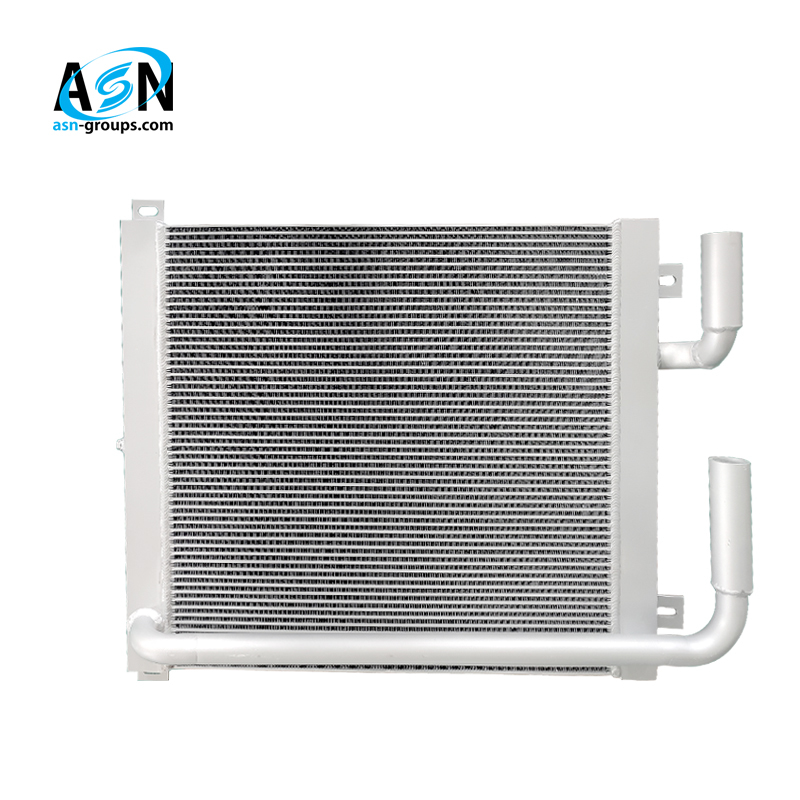
An air to air heat exchanger is a simple but clever device. It transfers heat from one air stream to another without allowing the two air streams to mix. Inside the unit, there is a core made of thin aluminum plates—typically using materials like A3003, 3A21, or 5A02 aluminum alloy, which offer excellent thermal conductivity and corrosion resistance. Warm air from inside an enclosure (such as an electrical cabinet) flows through one set of channels, while cooler outside air flows through separate, sealed channels. Heat naturally moves from the warmer side to the cooler side through the aluminum plates.
Two common designs:
-
Crossflow: The two air streams move perpendicular to each other. Simple, compact, and widely used.
-
Counterflow: The air streams move in opposite directions, offering higher thermal efficiency (70% to 90% in many configurations).
Most industrial air to air heat exchangers use only two small fans—one to circulate internal air and one to draw in external air. That is it. No compressor. No refrigerant. No expansion valve. No complex refrigeration cycle.
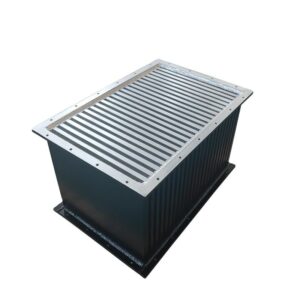
Key technical features (based on real product specifications)
| Parameter | Typical Range |
|---|---|
| 재료 | Aluminum (A3003/3A21/5A02) |
| Max outer dimensions | Customized up to 4000×4000×1000mm |
| Production technique | 진공 브레이징 및 아크 용접 |
| Max working pressure | Up to 2.6 MPa |
| Warranty | 1 year |
| MOQ | 1 piece |
The air to air heat exchanger is built using vacuum brazing, which creates strong, leak-free joints between the aluminum plates and fins. This manufacturing method ensures high heat transfer performance and long-term reliability—even in demanding industrial environments.
Traditional Cooling Methods: What You Are Probably Using Now
Let us be honest about what traditional cooling systems actually do. Most industrial enclosures today use compressor-based air conditioners or vortex coolers. These systems work, but they come with baggage.
Compressor-Based Air Conditioners
These use a vapor-compression refrigeration cycle—the same technology as your home air conditioner. A compressor pressurizes refrigerant gas, which releases heat as it condenses. The liquid refrigerant then expands and evaporates, absorbing heat from inside the enclosure.
What they do well:
-
Can cool below ambient temperature (making the inside of an enclosure colder than the outside air)
-
Work effectively in high outdoor temperatures (over 100°F / 38°C)
-
Handle high heat loads
What they do poorly:
-
High energy consumption—the compressor runs constantly or cycles frequently
-
Many moving parts (compressor, fans, valves) that can fail
-
Requires refrigerant—potential for leaks, environmental concerns
-
Complex maintenance—needs trained technicians
-
Higher upfront cost and lifecycle cost
-
Generates noise and vibration
For applications that genuinely need sub-ambient cooling or face extreme heat, a compressor-based system is necessary. But for many industrial enclosures—including telecom cabinets, outdoor instrumentation, LED lighting systems, and electrical control panels—that level of cooling is overkill.
Direct Comparison: Air to Air Heat Exchanger vs. Traditional Cooling
Let us put the two technologies side by side with real-world performance factors.
| 기능 | 공기 대 공기 열교환기 | Compressor-Based A/C |
|---|---|---|
| Cooling principle | Passive heat transfer through aluminum plates | Active refrigeration cycle |
| Can it cool below ambient? | No (cannot go colder than outside air) | Yes (can achieve much lower temperatures) |
| Energy consumption | Very low (only two small fans) | High (compressor is power-hungry) |
| Moving parts | Two fans (sometimes none with natural convection) | Compressor + fans + valves |
| Typical lifespan | 10–15 years (fans may need replacement) | 5–8 years (compressor failure common) |
| 유지 관리 | Clean filters and fans occasionally | Refrigerant checks, compressor service, coil cleaning |
| Noise level | Low (fan noise only) | Moderate to high (compressor hum and fan noise) |
| Refrigerant | None | Yes (potential leaks, environmental concerns) |
| Vibration | Minimal | Noticeable |
| Upfront cost | 낮음에서 보통 | 높음 |
| Operating cost | Very low | High (electricity for the compressor) |
| Best application | Enclosures where internal temp can be > ambient by 5–15°C | Enclosures needing precise sub-ambient cooling |
The key trade-off: The air to air heat exchanger cannot cool below the outside air temperature. If your internal equipment can tolerate temperatures slightly above ambient (for example, 95°F when outside is 85°F), then the air to air heat exchanger is perfect. If you need to keep the inside at 70°F when the outside is 100°F, you need a compressor-based system.
Five Scenarios Where an Air to Air Heat Exchanger Is the Best Choice
Let us get specific about real-world applications.
1. Outdoor Telecom Cabinets
Telecom equipment generates heat, but it is designed to operate across a wide temperature range—typically -40°C to +55°C. Inside a cabinet, temperatures can climb 10°C to 20°C above ambient. An air to air heat exchanger can easily remove that excess heat using only two fans. No compressor means no worry about refrigerant leaks in remote locations. No complex maintenance. Just reliable, silent cooling year after year.
2. Electrical Enclosures in Factories
Control panels for motors, PLCs, and drives generate moderate heat. In many factory environments, the ambient temperature is already controlled (air-conditioned or ventilated). The enclosure only needs a small temperature reduction to keep components within their rated operating range. An air to air heat exchanger is ideal—low power consumption, no vibration that could loosen terminal connections, and no refrigerant to handle.
3. LED Lighting Systems
High-power LED lights produce heat that reduces their lifespan and light output. Many outdoor LED fixtures (streetlights, stadium lights, billboard lights) are sealed against moisture and dust. An air to air heat exchanger can be integrated into the housing to move heat from inside the sealed chamber to the outside. It is compact, requires no maintenance, and lasts as long as the LEDs themselves.
4. Outdoor Instrumentation and Measurement Devices
Weather stations, air quality monitors, and industrial sensors are often housed in small enclosures exposed to the sun. Solar radiation can heat the enclosure far above the actual air temperature. An air to air heat exchanger uses the cooler ambient air to remove that solar heat gain, keeping internal temperatures stable without the complexity and power draw of an air conditioner running off solar panels.
5. Food and Beverage Processing Areas
In food production facilities, washdown requirements mean enclosures must be sealed against moisture and chemicals. Compressor-based coolers have coils and fins that can trap debris and are difficult to clean. An air to air heat exchanger has a smooth, sealed core that can be easily wiped down. No refrigerant lines to leak. No condensate to drain. It is a cleaner, safer solution.
Scenario Where Traditional Cooling Is Still Better
Honesty requires acknowledging where the air to air heat exchanger is not the right choice.
You need compressor-based cooling when:
-
The inside of the enclosure must be colder than the outside ambient temperature.
-
The ambient temperature regularly exceeds the maximum allowable internal temperature of your equipment.
-
You have extremely high heat loads (hundreds or thousands of watts) that passive heat exchange cannot handle efficiently.
-
Your equipment has very tight temperature tolerances (for example, precision instrumentation that drifts with ±1°C changes).
In these cases, an air conditioner or a thermoelectric cooler may be necessary despite their higher costs and lower reliability. But for the vast majority of industrial enclosures, the required cooling is simply to keep the inside from getting too much hotter than the outside—and that is exactly what an air to air heat exchanger does best.
Energy Savings: Real Numbers
Let us put some numbers behind the efficiency claim.
A typical small compressor-based enclosure air conditioner (500–1000 BTU/hour) might draw 150–300 watts of power when the compressor is running. Over a 24-hour day, especially in warm weather, it could run 50% to 80% of the time. That is 1.8 kWh to 5.8 kWh per day.
A comparable air to air heat exchanger with two small fans (each drawing perhaps 10–20 watts) would draw 20–40 watts continuously. That is 0.48 kWh to 0.96 kWh per day.
The annual difference: At 10 cents per kWh, a compressor unit might cost 65–65–210 per year to operate. The air to air heat exchanger costs 17–17–35 per year. Over five years, the savings easily exceed the purchase price of the heat exchanger.
And that is just electricity. Add in maintenance costs—compressor service calls, refrigerant recharges, fan replacements—and the gap widens further.
Durability and Maintenance: A Clear Winner
One of the biggest advantages of an air to air heat exchanger is its simplicity. With no compressor, no refrigerant, and no expansion valve, there are fewer things to break.
What can fail on an air to air heat exchanger:
-
Fans (the only moving parts, easily replaceable)
-
Clogged filters (simple cleaning)
What can fail on a compressor-based cooler:
-
Compressor (expensive, requires replacement of the whole unit or major repair)
-
Refrigerant leaks (requires leak detection, recharging)
-
Start capacitors and relays
-
Expansion valves
-
Coil corrosion
-
Condensate drain clogs (leading to water inside the enclosure)
The air to air heat exchanger is built using vacuum-brazed aluminum construction. The same technique is used in aerospace and automotive heat exchangers. It creates a solid, leak-proof core that can withstand vibration, thermal cycling, and years of operation. According to product specifications, units can be customized to fit almost any enclosure size—with maximum dimensions up to 4000×4000×1000mm if needed—and can handle working pressures up to 2.6 MPa.
Warranty is typically one year, but the core itself can last a decade or more. Fans may need replacement every 3–5 years, depending on usage and environment, but that is a low-cost, straightforward repair.
Customization Options for Industrial Applications
One of the strengths of modern air to air heat exchangers is their flexibility. Unlike off-the-shelf air conditioners that come in fixed sizes and capacities, aluminum plate-fin heat exchangers can be custom-engineered to fit almost any enclosure.
Based on real product capabilities, here is what can be customized:
| Customization Option | Details |
|---|---|
| Dimensions (L×W×H) | Up to 4000×4000×1000mm |
| 재료 | A3003, 3A21, 5A02 aluminum alloys |
| Working pressure | Up to 2.6 MPa (customizable) |
| 열 용량 | Application-specific design |
| Air flow rate | Customized via fin density and fan selection |
| Inlet/outlet temperatures | Based on your operating conditions |
| Logo | Customized printing (minimum 1 set) |
| Packaging | Customized (minimum 1 set) |
| Graphic design | Customized (minimum 1 set) |
Even the voltage of the fans can be customized. This means you can integrate the air to air heat exchanger seamlessly into your existing control system—whether it runs on 12V DC, 24V DC, 110V AC, or 220V AC.
The minimum order quantity is just one piece, making it feasible for prototype builds or one-off custom enclosures. Sampling and draft design services are available to ensure the cooler fits perfectly before full production.
Installation Best Practices
Getting the most from your air to air heat exchanger requires proper installation. Here are the key points:
Mounting: The unit should be mounted securely to the enclosure wall, with a gasket to prevent air leakage between the internal and external airstreams. The external side must have unobstructed airflow—do not place the unit in a corner or directly against another object.
Airflow direction: Most units are designed for specific inlet and outlet orientations. Pay attention to the arrows marked on the core. Reversing the flow direction can reduce efficiency by 30% or more.
Filter maintenance: Both internal and external air inlets should have washable or replaceable filters. In dusty environments, check filters monthly. A clogged filter on the external side can reduce cooling capacity dramatically.
Fan wiring: Use the correct voltage and polarity. Many units use DC fans that are polarity-sensitive. If the fan runs backward, it will still move air, but at much lower efficiency.
Sealing: Any air leak between the internal and external sides bypasses the heat exchanger core and reduces effective cooling. Use closed-cell foam gaskets and ensure mounting screws are tight.
자주 묻는 질문
1. Can an air to air heat exchanger cool below the outside air temperature?
No. It can only bring the internal temperature down to roughly the outside ambient temperature, minus a small efficiency loss. If you need sub-ambient cooling, you need a compressor-based system or a thermoelectric cooler.
2. How efficient is a typical air to air heat exchanger?
Counterflow designs achieve 70% to 90% thermal efficiency, meaning they transfer that percentage of the available temperature difference from the warm side to the cool side.
3. Does an air to air heat exchanger work in high outdoor temperatures?
Yes, but with a limitation. If it is 40°C (104°F) outside, the inside of your enclosure will be at least that warm. If your equipment can tolerate 40°C, it works fine. If your equipment needs 30°C, it will not.
4. What maintenance does an air to air heat exchanger require?
Clean or replace the air filters every 1–3 months, depending on dust levels. Listen for unusual fan noise (indicating bearing wear). That is typically all that is needed.
5. Can I get a custom-sized air to air heat exchanger for my specific cabinet?
Yes. Many manufacturers, including ASN Cooler, offer full customization of dimensions, materials, pressure rating, and thermal capacity with a minimum order quantity of just one piece.
The Bottom Line: Which Is Best for You?
There is no single answer that works for everyone. But here is a simple decision guide:
Choose an air to air heat exchanger if:
-
Your equipment can operate reliably at temperatures equal to or slightly above the local maximum ambient temperature.
-
You want the lowest possible operating cost and maintenance burden.
-
Your enclosure is in a location where compressor noise or vibration is a concern.
-
You need a compact, lightweight cooling solution.
Choose a compressor-based air conditioner if:
-
Your equipment has a maximum operating temperature lower than the peak ambient temperature (for example, equipment rated for 30°C in a location that reaches 40°C).
-
You need precise, sub-ambient temperature control.
-
Your heat load is very high (hundreds of watts) and cannot be handled by passive exchange.
-
You have no other way to remove heat.
For the vast majority of electrical enclosures, telecom cabinets, outdoor instrumentation, and industrial control panels, the air to air heat exchanger is the superior choice. It is simpler, cheaper to run, more reliable, and easier to maintain. It does not use refrigerants, does not vibrate, and does not require expensive service calls.
The next time you spec a cooling solution for an enclosure, ask yourself: does this really need a compressor? If the answer is no, an air to air heat exchanger is probably the best choice you can make.
Ready to explore an air to air heat exchanger for your application? Request a custom design based on your enclosure dimensions, heat load, and operating environment. With no minimum order quantity on custom units and free replacement parts available, getting the right solution is easier than ever. Contact the team at ASN Cooler to discuss your specific cooling needs and get a quote tailored to your project.