


Temperature is one of the most highly underrated factors in the performance stability of any industrial setup. Be it a manufacturing plant of enormous scale or a system of hydraulic presses or even construction machinery with heavy-duty operations, unavoidable heat generation within hydraulic systems takes place. This is not a design defect but simple physics. How efficiently that heat is managed determines the lifespan of your equipment, how safely it runs, and how amount of energy you can save in the long run.
Of the many elements that are made to regulate temperature, the Hydraulic Aluminum Oil Cooler emerges as the silent guardian-simple in its looks but extremely elegant in its function. It does not make noise, it does not draw attention to itself, but silently makes sure that everything else around it continues to work perfectly.
The Heat Challenge in Hydraulic Systems
All hydraulic systems operate on fluid power. The oil inside serves as a medium for the transmission of power and, at the same time, acts as a lubricant. When fluid is being pushed through pumps, valves, and hoses at high pressure, naturally, it will experience friction and internal resistance. These will generate heat. The processes are continuous.
Think of a closed-loop hydraulic circuit running continuously in an industrial application. Not only does the oil get increasingly hotter, but it also starts to break down and lose viscosity, hence reducing lubrication as well as the protection properties against wear for moving parts. If allowed to run without being cooled, the oil can easily attain temperatures that will support oxidation, sludge formation, destroy seals, and even destroy components.
Extreme warmth is, thus, a secret adversary. A couple of degrees above the suggested range can reduce the lifespan of hydraulic parts by half. This is the reason why hydraulic oil coolers are not an optional extra- they are a fundamental piece of the system’s survival.
What Exactly Is a Hydraulic Aluminum Oil Cooler?
A Hydraulic Aluminum Oil Cooler is a specific type of heat exchanger that takes the unwanted heat from hydraulic oil, and gives this heat to another medium, usually air or water, so that the oil can stay within a safe and efficient temperature range.
Aluminum does not just make up the body by accident. Aluminum is light in weight, does not corrode easily, and conducts heat very well. It can pick up and dispose of heat fast; therefore, there will be no need to add extra bulk for storage of heat or make the system more complicated to maintain.
Hydraulic oil coolers today mostly use either plate-fin or bar-and-plate types. In these, many thin aluminum plates are put together to make changing paths for both oil and air. As hot oil goes through one way and cooler air moves in the next, heat is well passed from the oil to the air.
A unit comes out small, tough, and very good at work, keeps hydraulic oil at the right heat makes sure things run well for a long life of the system.
The Working Principle: Step by Step
A simple though elegant process of thermal exchange describes the operation of a Hydraulic Aluminum Oil Cooler.
During operation of the hydraulic system, the oil picks up heat from energy being expended through actuators and mechanical parts. When the oil attains a preset temperature, it is routed via the inlet to enter into the oil cooler. It travels inside through channeling or platings made out of aluminum that are very much in contact with some cooler medium-whether air or fluid.
The temperature difference is what matters-heat always flows from the hotter surface to the cooler one. The hot hydraulic oil gives up its heat through the aluminum walls to the cooling medium. In most industrial installations, the cooling medium happens to be air that a fan drives. The fan forces air through the cooler fins, carrying away the heat energy.
By the time it gets out of the cooler outlet, it would have dropped much heat and is ready to go back into the hydraulic system at a reduced temperature. This will ensure that the system runs at thermal balance, hence no overheating—consistent performance.
It is an amazingly simple yet scientifically accurate process —perfection in engineering efficiency.
Inside the Construction: What Makes It Work
The structure of a Hydraulic Aluminum Oil Cooler might look minimal from the outside, but internally it is a carefully engineered combination of channels, fins, plates, and flow paths. Each part serves a vital purpose.
-
Aluminum Heat Core: This is the heart of the cooler. It consists of multiple thin plates or bars where the oil and cooling air flow in alternating paths.
-
Cooling Fan and Motor Assembly: Typically powered by 220V or 380V electricity, the fan draws ambient air across the fins to accelerate heat removal.
-
End Tanks and Manifolds: These direct the oil flow evenly through the core, ensuring that every section participates in heat exchange.
-
Pressure-Resistant Housing: Built to handle pressures up to 100 bar, it ensures safety and durability even under extreme working conditions.
-
Mounting Frame and Vibration Pads: They absorb vibration and reduce stress during operation, especially in mobile or industrial machinery.
Everything in this system is designed to support one goal—efficient, stable cooling without energy waste or maintenance complexity.
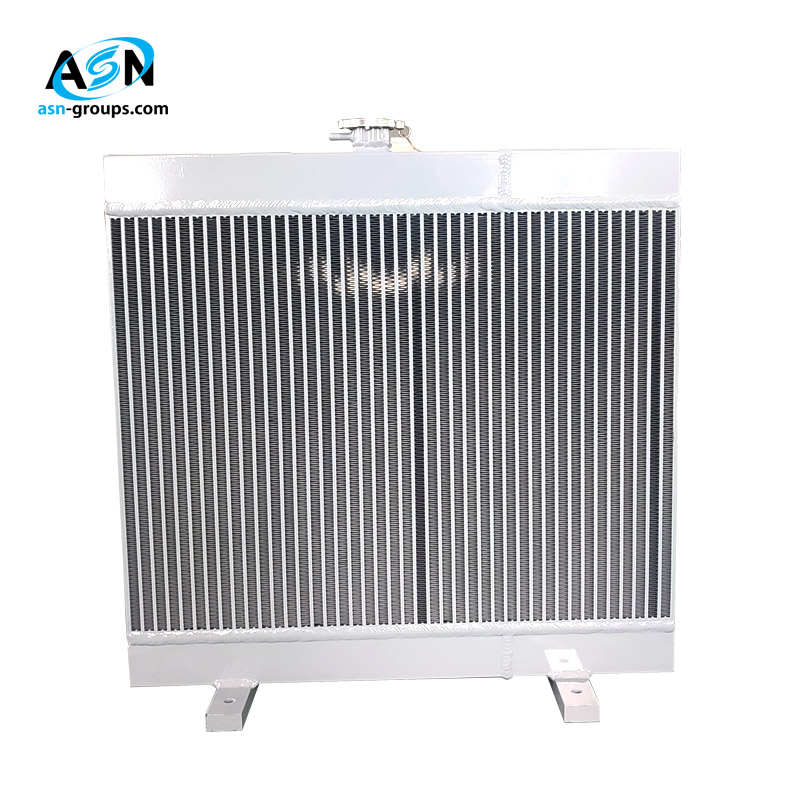
Why Aluminum Makes a Difference
If you have ever questioned why so many modern oil coolers are of aluminum and not copper or steel, let performance be the reason, and practicality another.
Aluminum has high conductivity when compared to its weight, three times lighter than steel-yet having mechanical strength almost equivalent to that of properly alloyed steel. It is also very resistant to corrosion and vibration; it does not rust. Aluminum parts can be made by extrusion and brazing with accuracy; thus, internal complexities that give maximum surface area for cooling are achievable without an increase in size.
Also, aluminum’s low price in large-scale production lets sellers give good prices while keeping high quality, making it the pick of the bunch for both factory OEMs and aftermarket users.
How It Supports Hydraulic System Efficiency
Cooling is not only about comfort—it’s about control, performance, and economy. In hydraulic systems, oil temperature directly influences viscosity, pressure stability, and energy transfer.
When oil is too hot, it becomes thin and loses its ability to create the proper film between moving parts. When it’s too cold, it becomes thick, causing high resistance and slow system response. The Hydraulic Aluminum Oil Cooler ensures that oil stays within the ideal range, typically between 40°C and 60°C.
This stability provides multiple benefits:
-
Consistent pressure and smooth actuation of hydraulic components
-
Reduced risk of cavitation and fluid aeration
-
Extended lifespan of pumps, valves, and seals
-
Lower energy consumption since less power is needed to maintain system performance
By controlling temperature, the cooler essentially becomes the system’s thermal regulator—keeping efficiency, durability, and reliability in perfect balance.
Key Features That Define a Modern Hydraulic Aluminum Oil Cooler
(First of the three list-style sections)
-
Lightweight, durable aluminum construction that ensures maximum thermal efficiency
-
Wide operating temperature range from -10°C to +100°C for diverse environments
-
High-pressure resistance up to 100 bar, ensuring operational safety
-
Flexible flow capacity (5–800 L/min) suitable for various hydraulic systems
-
Energy-efficient fan operation using 220V input for consistent airflow
-
Easy maintenance and long service life, backed by a one-year warranty and quality inspection
Each of these features is not just a technical specification—they translate directly into practical performance benefits for operators, engineers, and maintenance teams.
Where Hydraulic Aluminum Oil Coolers Are Used
The versatility of these coolers makes them indispensable across countless industries. You can find them in everything from factory production lines to agricultural machines, marine equipment, and even renewable energy systems.
- Manufacturing Plants: Hydraulic presses, molding machines, and material handling systems rely on continuous operation. Without effective cooling, downtime and energy loss become costly problems.
- Construction Equipment: Excavators, loaders, and cranes work under heavy loads for long hours. An oil cooler prevents the hydraulic circuits from overheating even in high ambient temperatures.
- Marine and Offshore Applications: Aluminum’s corrosion resistance makes it ideal for salty, humid environments like ship decks and oil rigs.
- Agricultural Machinery: Tractors, harvesters, and forestry machines require reliable thermal control for smooth hydraulic performance in all weather conditions.
- Energy and Power Systems: Wind turbines and hydroelectric mechanisms use hydraulic actuators that must remain temperature-stable to perform consistently.
The common thread among all these industries is simple—when reliability matters, a Hydraulic Aluminum Oil Cooler becomes an irreplaceable component.
Maintenance and Long-Term Care
Although hydraulic oil coolers are designed to be durable, proper maintenance can significantly extend their lifespan. Routine care is straightforward but essential:
-
Keep the fins clean: Dust, oil mist, or debris can block airflow and reduce cooling efficiency.
-
Monitor oil quality: Dirty or oxidized oil can leave deposits that clog internal channels.
-
Check for leaks and corrosion: Periodically inspect fittings and seals for early signs of wear.
-
Ensure correct fan operation: Listen for noise or vibration that may indicate bearing wear.
By maintaining these simple habits, operators ensure stable cooling performance, lower repair costs, and reduced energy waste over the system’s entire lifespan.
The Hidden Economics of Cooling Efficiency
Most people do not realize how much money over time inefficient cooling costs. For every degree of unneeded heat added to the unit, oil will oxidize more rapidly, and component life will be reduced. That requires more frequent oil changes, more downtime, and a higher maintenance budget.
A Hydraulic Aluminum Oil Cooler practically pays for itself by averting such losses. When oil is maintained at ideal operating temperature, friction losses, energy wastage, and equipment wear are minimized. Months or years of continuous operation translate into substantial savings in operation, particularly in large-scale plants where several hydraulic systems are running concurrently.
Why Industrial Engineers Prefer Plate Heat Exchanger Design
(Second list-style section)
-
Compact Size, Maximum Efficiency: Plate exchangers use thin, stacked aluminum plates, creating a large heat transfer surface in a compact volume.
-
Counterflow Heat Transfer: The oil and air flow in opposite directions, maximizing temperature gradient and thermal performance.
-
Ease of Customization: Engineers can adjust plate size, spacing, or flow paths to suit specific flow rates and operating pressures.
This adaptability makes plate-type aluminum coolers ideal for OEM integration or system upgrades without major redesign.
Environmental and Energy Benefits
In a world of energy, the Hydraulic Aluminum Oil Cooler also plays a part in going green. It cuts down on energy waste, stops heat, saves oil, and thus reduces the total carbon footprint of industrial work.
Cooler oil means less friction, lower fumes from burned hydraulic fluid, and longer service times—all add up to cleaner, greener making. Aluminum itself can be used again, which also fits more with today’s green rules.
Choosing the Right Hydraulic Aluminum Oil Cooler
Selecting the correct model is not just about size—it’s about matching your system’s requirements. Engineers should evaluate:
-
Flow rate compatibility (5–800 L/min depending on system scale)
-
Pressure rating and temperature range
-
Installation space and mounting options
-
Type of cooling medium—air or water
-
Material quality and corrosion protection
A well-matched cooler ensures that the entire system operates at peak efficiency without thermal bottlenecks.
Why Companies Choose Our Hydraulic Aluminum Oil Cooler
(Third and final list-style section)
-
Competitive pricing without sacrificing industrial-grade performance
-
Precision engineering and advanced aluminum brazing for maximum heat transfer
-
Comprehensive testing with inspection reports and quality certification
-
Customizable design for various flow capacities and voltage options
-
Global support and documentation, ensuring smooth operation worldwide
Each cooler represents a commitment to reliability, energy efficiency, and long-term value.
Beyond Technology: The Human Side of Reliability
There’s an operator or a technician, or an engineer behind every machine. Just like there’s one who feeds, bathes, and takes the kid to school. A Hydraulic Aluminum Oil Cooler is far more than just some numbers on a data sheet; it’s a trust. When your machine does not overheat during a demanding production run, when your maintenance team finishes a shift without unplanned downtime – that is when you start to understand what real reliability is.
Which is why the industry standard has become high-quality aluminum coolers because they represent precision as well as endurance and balance – three of the values of modern industrial success.
The Hydraulic Aluminum Oil Cooler is more than just some heat exchanger; it’s the very stabilizing heart in every hydraulic system. It silently manages temperature to protect components, extend oil life, and ensure unfailing performance. Its design is an ideal convergence of engineering logic and practical utility, based on the natural flow of thermal energy and the superior properties of aluminum.
Used on a large excavator, an assembly line at a factory press, or even a marine hydraulic system, this cooler works in one way: to allow energy to flow as it should while protecting the system from the deleterious effects of heat.
In the world of industrial automation processes, where downtime equates to production loss running into thousands of dollars, and temperature variations can significantly affect the performance of a machine, the Hydraulic Aluminum Oil Cooler emerges as one of the vital yet unsung components in modern industry. Sometimes, it is with the quietest parts that the loudest difference is made.