


Introduction
Choosing the right hydraulic oil cooler is not about finding a universally “better” option—it is about matching the cooling system to your specific application.
In general, an air-cooled hydraulic oil cooler is the preferred choice when you need a compact, self-contained solution that is easy to install and suitable for mobile machinery or remote industrial sites where water supply is limited or unreliable. In contrast, a water-cooled hydraulic oil cooler is typically selected when the system requires higher heat rejection capacity, more stable temperature control, and consistent performance even in high ambient temperatures.
Both cooling methods are widely used in industrial hydraulic systems, but they are designed for very different operating conditions. The real challenge for engineers and equipment buyers is not understanding which one is “better,” but identifying which one delivers the most reliable performance under their actual working environment and load conditions.
Why Hydraulic Oil Cooling Is Critical in Every System
Every hydraulic system generates heat as an unavoidable byproduct of energy conversion. This heat comes from internal fluid friction, mechanical inefficiencies in pumps and motors, and pressure losses as oil flows through valves, hoses, and fittings. In practice, even high-efficiency systems convert a significant portion of input energy into heat instead of useful mechanical output.
For example, a high-efficiency piston pump may reach around 90% efficiency under ideal conditions, but overall system efficiency often drops further once transmission and control components are included. In continuous operation, this means a substantial amount of energy is converted directly into heat that must be removed to maintain system stability.
When hydraulic oil temperature rises beyond its optimal operating range—typically around 50–60°C—system performance begins to degrade. Oil viscosity decreases, internal leakage increases, and lubrication efficiency drops. Over time, elevated temperatures accelerate oil oxidation, forming sludge and deposits that can block valves and filters. At the same time, seals and hoses are subjected to thermal stress, increasing the risk of premature failure and unplanned downtime.
In severe cases, excessive hydraulic oil temperature can lead to safety risks and costly equipment damage, making proper thermal management not just a performance requirement, but a critical reliability factor in industrial operation.
Air Cooled vs. Water Cooled: A Side-by-Side Comparison
Let us start with a high-level comparison before diving into the technical details. The table below summarizes the key differences between the two cooling technologies for hydraulic oil cooler applications.
| Feature | Air-Cooled Hydraulic Oil Cooler | Water-Cooled Hydraulic Oil Cooler |
|---|---|---|
| Cooling medium | Ambient air | Water (or water-glycol mixture) |
| Heat transfer efficiency | Moderate (lower thermal capacity) | High (4x greater thermal capacity than air) |
| Ambient temperature dependence | High – performance drops in hot environments | Negligible – stable regardless of room temperature |
| Initial cost | Lower – simpler design, no external plumbing | Higher – requires a water source and a circulation system |
| Operating cost | Electricity for the fan | Water pumping, treatment, and possible disposal fees |
| Installation complexity | Low – mount unit, connect the electrical and oil lines | High – requires water supply, return lines, and often a cooling tower or chiller |
| Portability | Excellent – ideal for mobile equipment | Poor – tied to water infrastructure |
| Space requirement | Larger footprint due to fan and fin array | Compact for equivalent cooling capacity |
| Noise level | Moderate to high (fan noise) | Low (no fan) |
| Maintenance | Clean fins regularly; check the fan motor | Prevent scale, corrosion, and fouling; manage water quality |
| Risk of cross-contamination | None | An internal leak can mix oil with coolant |
| Best applications | Mobile machinery, remote sites, dry climates, small to medium systems | Stationary industrial plants, high-heat loads, hot ambient conditions, precise temperature control |
This comparison shows the fundamental trade-off. Air cooling trades some efficiency for simplicity and independence. Water cooling trades some complexity for superior thermal performance.
Understanding Air-Cooled Hydraulic Oil Coolers
An air-cooled hydraulic oil cooler works much like a radiator in a car. Hot hydraulic fluid is pumped through a series of tubes. These tubes are covered in thin metal fins that dramatically increase the surface area exposed to the air. A fan – powered by an electric motor, a hydraulic motor, or even an engine-driven belt – forces ambient air across these fins. The moving air absorbs heat from the fins and carries it away, cooling the fluid inside the tubes.
When Air Cooling Makes Perfect Sense
Air-cooled hydraulic oil coolers are the most common choice for many applications, particularly in mobile equipment and standard industrial settings. They shine in specific scenarios.
First, if your equipment moves from place to place – think excavators, agricultural tractors, forestry machinery, or mobile cranes – an air-cooled unit is almost always the right answer. These machines cannot rely on a fixed water supply. An air-cooled hydraulic oil cooler carries its cooling medium with it, using the surrounding air regardless of where the machine operates.
Second, if you are working in a dry or remote environment where water is scarce or expensive, air cooling eliminates the need for water infrastructure. Some air-cooled hydraulic oil cooler designs require no water at all, making them ideal for desert operations, mining sites, and other water-constrained locations.
Third, if your hydraulic system has a moderate heat load – say, intermittent operation or relatively low continuous power – an air-cooled unit is often more than sufficient. Many smaller hydraulic power units, compact industrial machines, and mobile equipment fall into this category.
The Practical Advantages of Air Cooling
The simplicity of an air-cooled hydraulic oil cooler is its greatest strength. Installation typically requires only mounting the unit, connecting the oil lines, and wiring the fan motor (if electric). There is no water plumbing to run, no cooling tower to maintain, and no water treatment chemicals to purchase. This simplicity translates directly into lower upfront cost – generally a significant margin lower than a comparable water-cooled system.
Maintenance is also relatively straightforward. The fan and motor are the primary moving parts. Regular cleaning of the fin array to remove dust, dirt, and debris is essential – and usually easy to do with compressed air or a pressure washer. For stationary industrial units, many manufacturers recommend cleaning the condenser filter mesh at least once a week, or more often in dusty environments.
Portability is another major advantage. An air-cooled hydraulic oil cooler can be mounted in almost any orientation and moved from one machine to another without reconfiguring water connections. This makes them popular for rental equipment, field service trucks, and temporary installations.
The Limits of Air Cooling
However, air cooling has real limitations. The most significant is its dependence on ambient air temperature. When the surrounding air is hot, the temperature differential between the oil and the cooling medium shrinks, and heat transfer efficiency drops dramatically. In a hot workshop on a summer day, or in an outdoor machine operating in 35-40°C conditions, an air-cooled unit may struggle to keep oil temperatures within the desired range.
Consider the relationship: the cooling capacity of an air-cooled hydraulic oil cooler depends directly on the temperature difference (ΔT) between the oil inlet temperature and the ambient air temperature. If the ambient air is 35°C and you need to cool oil to 55°C, your ΔT is only 20°C. In cooler conditions with 20°C ambient air, the same cooler would have a 35°C ΔT and perform much better. This is why a properly sized hydraulic oil cooler for a hot climate needs significantly more surface area than one for a temperate location.
Noise is another consideration. The fan on an air-cooled unit can be loud, especially on larger coolers with high-speed motors. In a factory environment, this may not matter, but in residential areas or noise-sensitive settings, it could be a problem.
Understanding Water-Cooled Hydraulic Oil Coolers
A water-cooled hydraulic oil cooler uses water or a water-glycol mixture to remove heat from hydraulic fluid. Because water has a much higher thermal capacity than air, it absorbs and transfers heat more efficiently, making it ideal for high heat-load systems or environments where air cooling is limited by high ambient temperatures.
There are two main types: shell and tube, and brazed plate water-cooled hydraulic oil coolers.
-
Shell and Tube Oil Coolers
The shell and tube design is a traditional water cooling solution consisting of tubes housed inside a cylindrical shell. One fluid flows through the tubes while the other flows around them inside the shell, with baffles improving heat transfer through turbulence.
Shell and tube hydraulic oil coolers are valued for their durability and high-pressure resistance. They are widely used in power plants, marine engines, and heavy machinery, and many designs allow tube bundle removal for easier maintenance.
However, they are bulkier and generally less efficient than plate-type coolers when handling low-viscosity hydraulic oil.
-
Brazed Plate Oil Coolers
The brazed plate cooler is a compact, modern design made of thin corrugated plates brazed together to form alternating flow channels for oil and water. This structure provides a large heat transfer area within a small footprint.
Brazed plate hydraulic oil coolers offer higher thermal efficiency than shell and tube types, especially for low-viscosity fluids. They are lightweight, space-saving, and scalable by adding plates. However, they are less suitable for very high-pressure systems.
-
Where Water Cooling Excels
Water-cooled hydraulic oil coolers are commonly used in stationary industrial systems requiring stable and efficient temperature control.
Typical applications include hydraulic presses, injection molding machines, mining equipment, and power generation systems operating under continuous load.
Unlike air-cooled systems, water-cooled hydraulic oil coolers are not affected by ambient air temperature. As long as water supply conditions remain stable, cooling performance stays consistent even in hot environments.
They also provide tighter temperature control, which is important for precision hydraulic systems such as servo-driven machinery and high-accuracy manufacturing equipment.
-
The Complications of Water Cooling
Despite high efficiency, water cooling adds system complexity.
A water-cooled hydraulic oil cooler requires a reliable water source such as a cooling tower, chiller, or industrial water supply. This increases installation requirements, including piping, pumps, and system integration.
Operating costs are higher due to water treatment, pumping energy, and maintenance to prevent scaling and corrosion.
Leakage is another risk. Internal failure may cause cross-contamination between oil and water circuits, potentially damaging hydraulic components and creating environmental issues.
How to Size a Hydraulic Oil Cooler Correctly
Selecting the wrong size of hydraulic oil cooler – whether air-cooled or water-cooled – is a costly mistake. Undersized cooling leads to overheating, oil degradation, and premature component failure. Oversized cooling wastes money on unnecessary capacity and may cause overcooling, which raises oil viscosity and reduces system efficiency.
Calculating Heat Load
The first step in sizing any hydraulic oil cooler is determining the system’s heat load – the amount of thermal energy that must be rejected per unit of time. The most practical method is to use the system’s continuous input power. If a hydraulic system has a continuous input power of 100kW and is 80% efficient, then 80kW is available at the output to do useful wor,k and 20kW is converted to heat. Your hydraulic oil cooler must be capable of rejecting at least 20kW of heat to maintain a stable oil temperature.
A more refined approach accounts for the native efficiency of the system components. A piston pump driving a piston motor is about 85% efficient. A gear pump driving a gear motor is only about 72% efficient. For a 100kW system, a gear pump/motor combination might require a hydraulic oil cooler capable of rejecting 35kW of heat, compared to 25kW for a piston-based system. Systems with accumulators, servo valves, or proportional valves may need a cooling capacity of 50-90% of the input power.
The industry rule of thumb is that heat load should be estimated at 30% of installed system input power. While not precise, this is a widely accepted starting point for preliminary sizing. For existing systems, a heat load test can be conducted by measuring the temperature rise of a known volume of fluid under full load conditions.
Other Sizing Parameters
Once heat load is determined, your hydraulic oil cooler must also be checked against several other parameters:
-
Flow rate: The cooler must handle the system’s oil flow without creating excessive pressure drop.
-
Operating temperature range: Recommended oil temperature is typically 40-60°C. The cooler must maintain oil temperature below the maximum rating of the hydraulic fluid – usually about 80-90°C for standard oil.
-
Ambient or water supply temperature: For air-cooled units, this determines the effective ΔT. For water-cooled units, inlet water temperature and flow rate are critical.
-
Maximum pressure rating: The cooler must withstand the system’s maximum operating pressure. Some brazed plate coolers are designed for lower pressures than shell and tube units.
A Real-World Example: ASN’s Aluminum Plate Hydraulic Oil Radiator
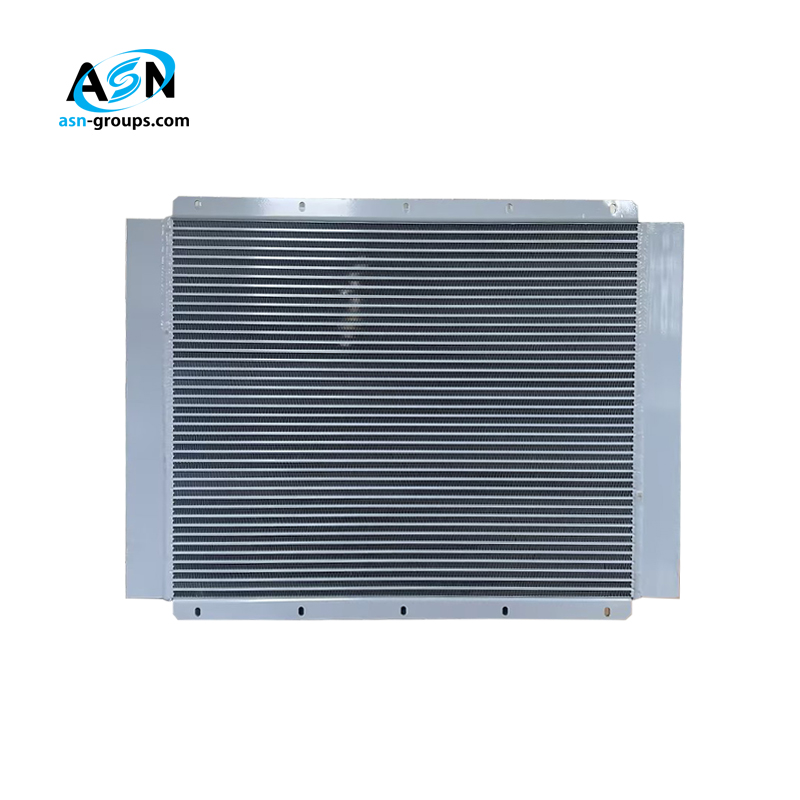
To see air-cooled technology in practice, consider a specific product: the aluminum plate hydraulic oil radiator offered by ASN HYD.technology Co., Ltd. This hydraulic oil cooler uses a compact plate heat exchanger design made from high-quality aluminum, providing fast cooling and stable operation. Its specifications give a concrete picture of what an air-cooled unit can deliver:
-
Cooling method: Air cooling
-
Flow capacity: 100 L/min
-
Maximum pressure rating: 26 bar
-
Working temperature range: -10°C to +100°C
-
Weight: 20 kg
-
Dimensions (LWH): 46 × 67 × 14 cm
This hydraulic oil cooler is designed for manufacturing plants, agricultural machinery, and industrial equipment. The aluminum construction reduces weight while maintaining strength, and the air-cooled design eliminates water usage and associated maintenance costs. With a maximum pressure rating of 26 bar and a 100 L/min flow capacity, it suits many medium-duty hydraulic systems commonly found on farms and in small factories.
This example illustrates the practical reality of air cooling: capable, cost-effective, and self-contained, but with limitations in extreme heat or very high flow conditions.
Maintenance Considerations for Both Types
Proper maintenance is essential for any hydraulic oil cooler to perform reliably over its service life. The maintenance requirements differ significantly between the two types.
Air-Cooled Hydraulic Oil Cooler Maintenance
Air-cooled units are relatively low-maintenance, but they cannot be ignored. The cooling fins are susceptible to clogging from dust, dirt, grass, and other debris. In dusty environments, cooling efficiency drops quickly as the fin passages fill up.
Recommended practices include:
-
Inspect fins regularly: Check the cooling fins carefully for debris accumulation.
-
Clean with compressed air or water: Use compressed air reduced to about 30 psi, or wash with water. When working in very dusty environments, cleaning may be needed daily.
-
Check the fan motor: Ensure the fan is operating correctly and listen for unusual noise.
-
Clean the filter mesh: If the unit has an inlet filter, remove it and wash with warm water and mild detergent, then dry completely before reinstalling.
The recommended cleaning interval for an air-cooled hydraulic oil cooler is typically every 4000 operating hours, or more frequently in harsh conditions. Operating a machine with obstructed cooling fins can cause damage due to overheating.
Water-Cooled Hydraulic Oil Cooler Maintenance
Water-cooled units require more specialized maintenance focused on water quality and internal cleanliness:
-
Prevent scale buildup: Scale deposits on heat transfer surfaces dramatically reduce efficiency. Water treatment is essential – either chemical treatment of closed-loop systems or filtration for once-through systems.
-
Inspect for corrosion: Depending on materials and water chemistry, corrosion can attack tubes, shells, and fittings.
-
Clean tube bundles: Shell and tube coolers with removable bundles can be pulled and mechanically cleaned. Chemical cleaning may also be used.
-
Monitor for leaks: Regular pressure testing and visual inspection help detect internal leaks before they cause cross-contamination.
-
Check water flow and temperature: Ensure the cooling water supply remains within design parameters.
For plate-type water-cooled hydraulic oil coolers, disassembly and cleaning of individual plates is possible but more labor-intensive. Some operators schedule comprehensive inspection and cleaning of the entire oil circuit system every 3-6 months, depending on oil quality.
FAQ
Q1: What is the ideal operating temperature for hydraulic oil in a system with a cooler?
The optimal range is typically 50-60°C (120-140°F). At this temperature, viscosity is correct for lubrication, and the oil resists oxidation. The hydraulic oil cooler should be sized to maintain oil below 80-90°C under full load.
Q2: Can I use a hydraulic oil cooler designed for water cooling with air cooling?
No. The two designs are fundamentally different. A water-cooled hydraulic oil cooler relies on water’s high thermal capacity and will not function properly with air. Attempting to use it without a water supply will cause severe overheating.
Q3: How do I know if my current hydraulic oil cooler is undersized?
Common signs include oil temperature consistently above 80-90°C under normal load, frequent thermal shutdowns, rapid oil degradation (darkening, sludge formation), and premature seal or pump failures. Calculate your actual heat load and compare it to the cooler’s rated capacity.
Q4: What happens if I oversize a hydraulic oil cooler?
Oversizing wastes money on unnecessary capacity. More importantly, excessive cooling can lower oil temperature below 40°C. At low temperatures, oil viscosity rises, causing sluggish operation, increased pressure drop, and reduced pump efficiency.
Q5: Can a hydraulic oil cooler be repaired, or should it be replaced?
Air-cooled units with damaged fins or fan motors are often repairable. Water-cooled units with leaking tubes or cracked plates can sometimes be repaired, but replacement is frequently more cost-effective. For critical applications, many operators replace rather than risk a hidden failure.
Conclusion
So, which is better—air-cooled or water-cooled? The answer depends entirely on your operating conditions and system requirements. An air-cooled hydraulic oil cooler is best for mobile equipment, moderate temperatures, limited water supply, and when simplicity and lower cost are priorities. It is widely used in industrial and agricultural machinery where a reliable, self-contained cooling solution is needed.
A water-cooled hydraulic oil cooler is more suitable for continuous high-load systems, high ambient temperatures, and applications requiring precise temperature control. With a stable water source, it delivers higher and more consistent cooling performance, making it ideal for heavy-duty industrial operations.
As a general rule, systems above 50–75kW or operating in temperatures above 32°C should consider water cooling, while smaller or mobile systems are better suited to air-cooled hydraulic oil coolers. The key is proper sizing based on heat load, duty cycle, and working environment to avoid overheating, inefficiency, or unnecessary cost.