


Introduction
A butterfly valve flange is a quarter-turn flow control device where a disc rotates 90 degrees to start, stop, or regulate fluids, gases, or slurries. Its compact design, lightweight construction, and cost efficiency make it ideal for large pipelines. The global high-performance butterfly valve market is projected to grow from USD 6.40 billion in 2025 to USD 10.90 billion by 2032, reflecting growing demand in water treatment, HVAC, chemical, and oil & gas systems. The flange connects the valve to piping via standardized bolt patterns—SAE, DIN, EN 1092, or ASME B16.5—ensuring a secure, leak-resistant joint. Properly specified and installed, a butterfly valve flange delivers reliable shut-off, easy maintenance, and long-term cost savings.
The Working Principle: Quarter-Turn Simplicity
A butterfly valve flange operates through a simple quarter-turn mechanism. A circular disc mounted on a shaft rotates 90 degrees to open, close, or regulate flow. When the disc is perpendicular to the flow path, the valve is closed; when parallel, media can pass through with minimal resistance.
This design offers a clear advantage over gate valves, which require multiple turns to operate. A butterfly valve moves from fully closed to fully open in a single quarter turn, making it ideal for applications that require fast response and easy automation.
In addition to isolation, a butterfly valve flange can also provide flow control. By positioning the disc at intermediate angles, operators can regulate flow rates and create a predictable pressure drop.
Disc materials vary by application. Aluminum provides a lightweight and economical solution, while stainless steel, ductile iron, and specialty alloys are preferred for more demanding environments. In many designs, the disc and shaft are integrated to improve sealing consistency and reduce long-term wear.
Why Flange Connections Matter
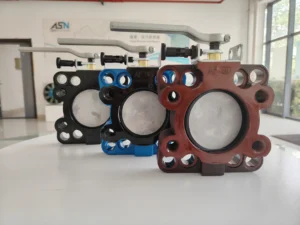
The flange is what connects the valve securely to the piping system. Unlike wafer-style valves that are clamped between pipe flanges, a flanged butterfly valve bolts directly to the pipeline, creating a stronger and more stable connection.
This added rigidity helps the valve withstand vibration, mechanical stress, and thermal expansion, particularly in larger piping systems. It also improves maintenance efficiency, as one side of the valve can often be disconnected without dismantling the entire pipeline.
Another advantage is end-of-line service capability. While wafer valves generally require support from flanges on both sides, a flanged butterfly valve can be installed against a blind flange and used to isolate the end of a pipeline.
Most butterfly valve flanges are manufactured to standards such as SAE, DIN, EN 1092, and ASME B16.5, ensuring compatibility with a wide range of industrial piping systems and simplifying installation.
End connection comparison: flanged vs. wafer vs. lug
Choosing the right end connection type is one of the most important decisions in valve selection. The table below compares the three main butterfly valve flange connection styles side by side.
| Connection Type | Installation | Maintenance | End-of-Line Service | Cost | Best Applications |
|---|---|---|---|---|---|
| Flanged | Bolt directly to pipe flanges | Disconnect one side independently | Yes | Higher (more material) | Large diameters, high pressure, dead-end service |
| Wafer | Sandwiched between flanges with through-bolts | Must disconnect both sides | No | Lowest | General isolation, low to medium pressure |
| Lug | Threaded inserts, bolted from both ends | Disconnect one side without draining the opposite pipe | Yes | Moderate | Maintenance-heavy systems, frequent disassembly |
The flanged butterfly valve sits at the premium end of this spectrum. It costs more than a wafer valve because the integral flanges require additional material and machining. For critical applications where system integrity cannot be compromised, the added cost is easily justified. Lug-style valves offer a middle ground—they support dead-end service and independent disconnection but rely on threaded inserts that can wear out over time. When you need maximum reliability and the ability to isolate and remove the valve without disturbing adjacent piping, a flanged butterfly valve is the correct choice.
Real-world applications: where butterfly valve flanges deliver
The versatility of a butterfly valve flange makes it suitable for an extraordinarily wide range of industries.
-
Water and wastewater treatment
Municipal water treatment plants rely on butterfly valves for raw water intake, filtration trains, chemical dosing lines, and treated water distribution. The valves handle everything from potable water to aggressive chemicals like chlorine and coagulants. In wastewater applications, butterfly valves control sludge lines, aeration basins, and effluent discharge. Their ability to handle suspended solids without clogging is a major advantage over other valve types.
-
HVAC systems
Heating, ventilation, and air conditioning systems use butterfly valve flanges for chilled water loops, hot water circuits, cooling tower isolation, and air handling unit controls. The compact design fits easily into mechanical rooms where space is at a premium, and the quarter-turn operation pairs naturally with electric or pneumatic actuators for automated building management systems.
-
Chemical and petrochemical processing
Chemical plants handle corrosive fluids, high temperatures, and hazardous materials. Butterfly valve flanges with PTFE liners or specialty alloy discs provide the chemical resistance needed for acids, bases, solvents, and aggressive process streams. The bidirectional sealing capability ensures that the valve maintains isolation even under fluctuating pressure conditions.
-
Oil and gas
From offshore platforms to refinery pipelines, butterfly valves control crude oil, natural gas, refined products, and cooling water circuits. High-performance triple-offset designs deliver bubble-tight shut-off under extreme pressures and temperatures, while resilient-seated valves handle lower-pressure utility services.
-
Food and beverage processing
Sanitary butterfly valves with polished stainless steel bodies and EPDM seals are common in dairy, brewery, and food processing plants. The smooth-bore design prevents product entrapment and simplifies cleaning-in-place (CIP) procedures. For this industry, a properly specified butterfly valve flange made of 316 stainless steel with food-grade elastomers is an essential component.
Material selection: building a butterfly valve flange for your service conditions
A butterfly valve flange is only as reliable as the materials from which it is constructed. Each component must be matched to the operating environment.
-
Valve body materials
Cast iron (GGG 40) offers excellent strength and corrosion resistance for water, air, and mild chemical services at a moderate cost. Ductile iron provides higher tensile strength and impact resistance, making it suitable for higher-pressure applications. Stainless steel (CF8, CF8M, or CF3M) delivers superior corrosion resistance for aggressive chemical environments, high-purity applications, and elevated temperatures. Aluminum alloy bodies offer weight savings for portable or suspended installations.
-
Disc materials
The disc rotates directly into the flow stream, so it must resist erosion and corrosion. Aluminum discs are lightweight and corrosion-resistant for water and mild chemical applications. Stainless steel discs provide the hardness and chemical resistance needed for abrasive or corrosive services. Nylon-coated ductile iron discs offer an economical alternative for applications where the coating remains intact.
-
Seal materials
The seat material determines the valve‘s chemical compatibility, temperature range, and shut-off capability. NBR (nitrile rubber) is oil-resistant and durable, with a temperature range of roughly -35°C to 100°C. It is commonly used in petroleum, fuel oil, and air systems. EPDM handles water, steam, dilute acids, alkalis, and ozone with a range of -40°C to 135°C. It is the standard choice for potable water and HVAC applications. PTFE (polytetrafluoroethylene) provides exceptional chemical resistance to almost all corrosive media, though it is a relatively rigid material; many PTFE seats incorporate a rubber backing layer to supply the compliance needed for bubble-tight sealing. Temperature limits for PTFE extend higher than elastomers, reaching up to 230°C in some formulations.
The blowout-proof stem: a critical safety feature
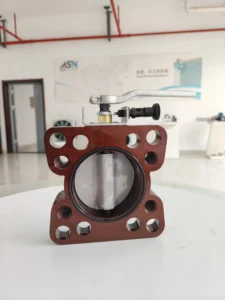
One safety feature that is often overlooked until something goes wrong is the stem retention mechanism. Under high pressure, the internal forces acting on a valve stem can be substantial. A conventional stem design relies on a snap ring or simple retainer to keep the stem from being ejected. If that retainer fails—or if it was never installed correctly—the stem can blow out of the valve body, releasing pressurized fluid or gas with potentially catastrophic consequences.
That is why premium butterfly valve flange designs incorporate a blowout-proof stem. The stem is machined with an integral shoulder or groove that physically prevents axial movement beyond a designed limit, regardless of what happens to external retainers. Even if the actuator is removed, the stem cannot come out of the valve body. Some designs use a double blowout-proof stem construction that meets the requirements of API 609 and ANSI B31.1, two of the most stringent industrial standards.
For any butterfly valve flange installed in a pressurized system, a blowout-proof stem is not an optional upgrade. It is a fundamental safety requirement that should be verified before purchase. ASN incorporates this design feature across its butterfly flange product line, ensuring that operators can work with confidence even under maximum rated pressure conditions.
Installation best practices: getting the most from your valve
A butterfly valve flange can only perform as well as its installation allows. Follow these guidelines to avoid common failure modes.
Alignment is everything. The valve disc must seat concentrically within the pipeline. Misalignment causes uneven sealing contact, leading to leaks and premature seat wear. Before tightening flange bolts, rotate the disc to a partially open position—typically 10 to 20 degrees—which allows the disc to self-center between the flanges. Once aligned, close the disc fully to check for binding or interference.
Bolt tightening sequence matters. Never tighten all flange bolts fully in sequence around the circle. That distorts the flange faces. Instead, use a cross-over (star) pattern, tightening bolts in several graduated steps: hand-tighten first, then apply approximately 25 percent of final torque, then 50 percent, then 75 percent, and finally full torque. This gradual, alternating approach ensures even flange compression and prevents gasket damage.
Never exceed recommended torque. Over-tightening flange bolts can crack the valve body or deform the seat. Consult the manufacturer‘s torque table for your specific valve size and material. When in doubt, use a calibrated torque wrench rather than relying on “feel.” Excessive bolt torque is one of the most common causes of premature butterfly valve flange failure.
Inspect the disc and seat before installation. Debris, shipping damage, or manufacturing defects in the sealing surfaces will cause leaks from day one. Rotate the disc through its full range of motion by hand before bolting the valve into place. Listen for unusual friction or grinding sounds. If the disc does not move smoothly, investigate before installation proceeds.
Consider gasket requirements. Some resilient-seated butterfly valves are designed to seal without separate flange gaskets—the elastomer seat extends to the flange faces and serves as its own gasket. Others require flat gaskets. Check the manufacturer‘s instructions. Using a gasket when the valve is designed for gasket-less installation, or failing to use one when required, both lead to leaks.
Maintenance and troubleshooting
A butterfly valve flange that is correctly sized, properly installed, and operated within its design limits requires minimal maintenance. A few simple checks keep it running for decades.
Periodic operation. Valves that remain in the same position for months or years can develop seat “memory” or sticking. Exercising the valve—opening and closing it fully several times a year—keeps the seat material flexible and clears any accumulated debris from the sealing surfaces.
Leak testing. If the valve fails to shut off completely, check first for debris trapped between the disc and seat. Operating the valve through several full cycles may dislodge the particle. If leakage persists, inspect the seat for damage or hardening. Many resilient seats are replaceable without removing the valve body from the pipeline.
Actuator verification. For automated valves, verify that the actuator is delivering its full rated torque and that it stops precisely at the closed position. An actuator that under-travels leaves the disc partially open; one that over-travels can damage the seat or the disc edge.
Common failure modes. Valve body cracking is sometimes caused by over-torquing flange bolts or by forcing the valve into a flange gap that is too narrow. Seat leakage often results from debris, worn elastomer, or misalignment. Stem leakage points to worn packing or, in severe cases, a damaged stem. Hard operation suggests disc-seat interference, bent shaft, or actuator misadjustment.
FAQ
1. Can a butterfly valve flange be used for throttling, not just isolation?
Yes. Butterfly valve flanges are well-suited for throttling applications, particularly in the mid-range of disc rotation (30 to 70 degrees open). However, avoid extended operation at very low openings, where high fluid velocity can erode the disc and seat.
2. What is the difference between a wafer and a flanged butterfly valve?
A wafer valve is sandwiched between two pipe flanges with long through-bolts passing around the valve body. A flanged butterfly valve has integral flanges and bolts directly to pipe flanges. Flanged valves cost more but offer easier maintenance and end-of-line service capability.
3. Is a butterfly valve flange suitable for steam service?
At low to moderate pressures, certain seat materials—EPDM or high-temperature PTFE—can handle saturated steam. For high-pressure or superheated steam, consider a high-performance or triple-offset butterfly valve with a metal seat.
4. How often should a butterfly valve flange be exercised?
Manufacturers recommend full open-close cycling at least once every six months for valves that remain in a fixed position. Valves in active service cycle automatically.
5. What is the maximum working pressure for a resilient-seated butterfly valve flange?
Standard resilient-seated butterfly valve flanges are rated for working pressures up to 7 bar (approximately 100 psi), with differential pressures up to 6 bar. High-performance designs extend significantly beyond these limits. Always consult the manufacturer‘s data sheet for your specific model.
Conclusion: A butterfly valve flange built for the long run
The shift toward butterfly valve flanges across industrial applications is not a trend—it is a recognition of engineering fundamentals. When you need quarter-turn speed, compact installation, reliable shut-off, and the ability to service one side of the valve without draining the entire system, a flanged butterfly valve delivers. The combination of blowout-proof stem safety, corrosion-resistant materials, and international flange standardization makes the butterfly valve flange a foundation component for any piping system that values uptime and low total cost of ownership.
Choosing the right butterfly valve flange is not simply a matter of connection type. Factors such as pressure rating, sealing requirements, operating media, maintenance access, and flange standards all influence long-term performance. A properly specified valve can improve system reliability, reduce downtime, and lower maintenance costs over its service life.
ASN HYD.technology Co., Ltd. manufactures butterfly flanges in SAE and DIN configurations, covering sizes from AF40 (1½”) to AF125 (5″). Whether the application involves water treatment, HVAC equipment, hydraulic systems, or industrial processing, selecting the correct flange specification is essential for achieving reliable and efficient flow control.