


Abstract
Hydraulic oil temperature plays a critical role in system reliability, yet it is often overlooked during equipment selection. Excessive oil temperatures can reduce viscosity, accelerate seal wear, and shorten component service life. Selecting the right hydraulic oil cooler is therefore essential for maintaining performance and controlling long-term operating costs.
This article compares air-cooled and water-cooled hydraulic oil coolers based on cooling performance, total cost of ownership, installation requirements, maintenance needs, and application suitability. From mobile machinery to high-load industrial systems, it provides practical selection criteria and a clear comparison to help engineers and buyers choose the most suitable cooling solution.
1|Cooling Principles: How Air-Cooled and Water-Cooled Systems Remove Heat
1.1 Air-Cooled Hydraulic Oil Cooler — Working Principle & Design Advantages
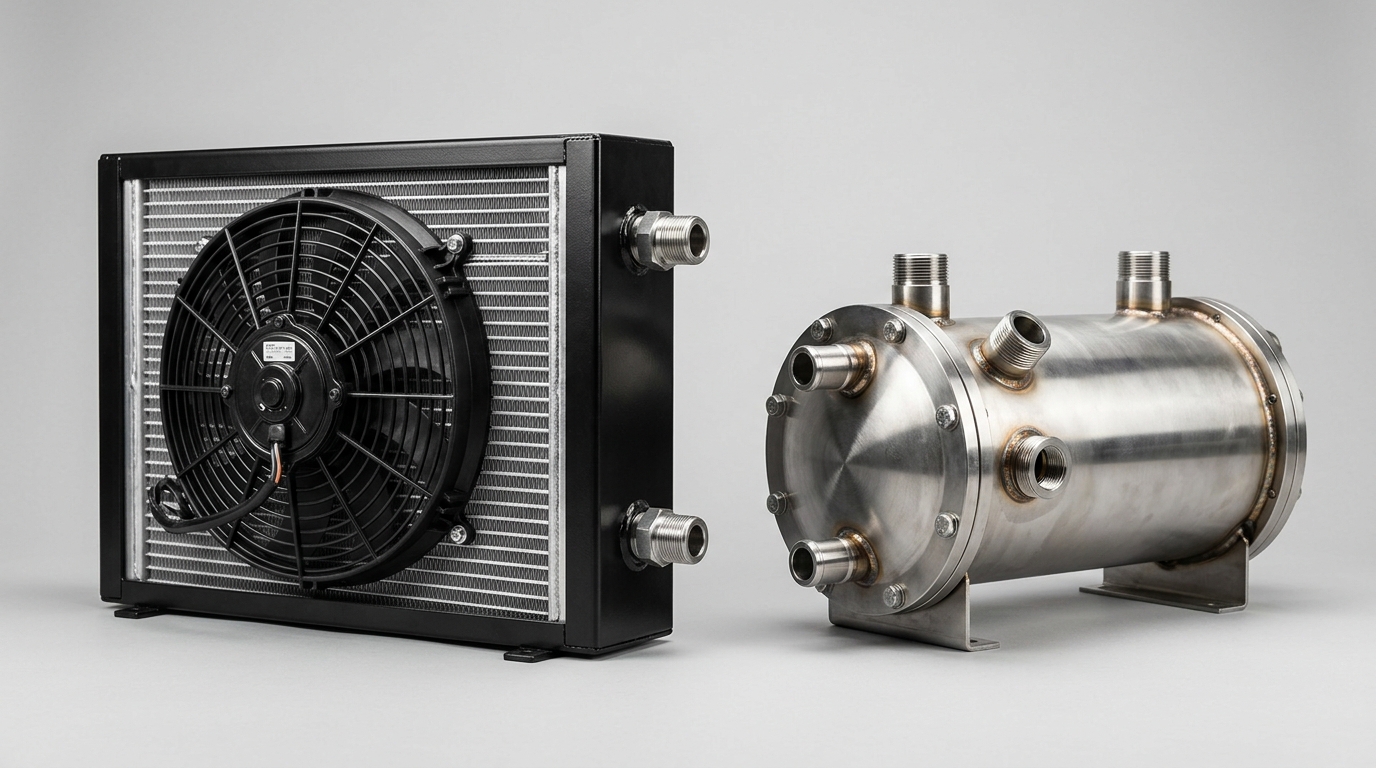
An air-cooled hydraulic oil cooler removes heat through forced convection. Hot hydraulic oil flows through a finned aluminum or copper-brass core, while a fan drives ambient air across the fin surface to transfer heat away from the oil. Since it does not require a separate water circuit, cooling towers, or additional infrastructure, it offers a simple and flexible installation solution.
Most air-cooled units use tube-and-fin or bar-and-plate core designs to increase heat transfer efficiency within a compact structure. Depending on application requirements, fan motors can be configured as AC, DC, or hydraulic-driven types, allowing installation on mobile equipment and industrial systems with different power conditions.
When selecting an air-cooled hydraulic oil cooler, buyers should consider factors such as fin spacing, airflow performance, core material compatibility, and the operating environment. Standard models can typically provide cooling capacities from several kilowatts to hundreds of kilowatts depending on design configuration.
1.2 Water-Cooled Hydraulic Oil Cooler — Working Principle & Design Advantages
A water-cooled hydraulic oil cooler transfers heat from hydraulic oil to a secondary cooling medium, usually plant water or a closed-loop chilled water system. Common designs include shell-and-tube and brazed plate heat exchangers, both of which provide efficient heat transfer through separate oil and water channels.
Because water transfers heat more efficiently than air, water-cooled systems are often preferred for high-load hydraulic applications, limited installation spaces, and environments with high ambient temperatures. For large heat loads, they can achieve higher cooling capacity within a smaller footprint compared with air-cooled alternatives.
The main limitation is infrastructure dependency. Water-cooled hydraulic oil coolers require reliable water supply, return piping, and proper water quality control. Without regular maintenance such as filtration, water treatment, and descaling, cooling performance may gradually decline.
2|Cost Analysis: Upfront Investment vs. Long-Term Operating Cost
2.1 Total Cost of Ownership (TCO) Comparison
From an initial investment perspective, air-cooled hydraulic oil coolers are usually more economical. Installation typically requires only the cooler, hydraulic connections, and electrical power, while water-cooled systems may involve additional costs for piping, pumps, cooling towers, or water treatment equipment.
For similar cooling requirements, the total installation cost of a water-cooled system can be significantly higher due to supporting infrastructure. However, long-term operating costs depend heavily on the application. Facilities with existing chilled water systems may achieve lower energy costs with water-cooled solutions, especially for continuous high-load operation.
Maintenance requirements also differ. Air-cooled units mainly require regular fin cleaning and fan inspection, particularly in dusty environments. Water-cooled systems require ongoing water quality management, including monitoring, chemical treatment, and scale prevention.
2.2 Hidden Costs Buyers Should Consider
Water-cooled systems may face hidden costs related to water quality issues. Scale buildup, corrosion, and contamination can reduce heat transfer efficiency and increase maintenance requirements if water conditions are not properly controlled.
Air-cooled systems, on the other hand, may experience reduced performance in high-temperature environments. When ambient temperatures exceed design conditions, additional cooling capacity or larger units may be required to maintain hydraulic oil temperatures within the recommended range.
Downtime risk should also be included in the total cost evaluation. Air-cooled systems generally have fewer auxiliary components, making repairs relatively straightforward. Water-cooled systems can involve more complex failures, especially when cooling water issues affect heat exchanger performance or hydraulic system reliability.
Air-Cooled vs Water-Cooled Hydraulic Oil Cooler — Parameter & Cost Comparison Matrix
| Parameter | Air-Cooled | Water-Cooled |
|---|---|---|
| Typical Cooling Capacity Range | 5 – 250 kW | 10 – 1,000+ kW |
| Initial Installation Cost Index | Low (1.0×) | High (1.4–1.7×) |
| Annual Operating Energy | Medium (fan motor continuous) | Low–Medium (depends on infrastructure) |
| Recommended Max Ambient Temp | ≤45°C (standard); ≤55°C (oversized) | ≤50°C water inlet |
| Maintenance Interval | 3–6 months (fin cleaning) | Monthly (water quality check) |
| Cooling Water Requirement | None | Required (hardness <200 ppm recommended) |
| Typical IP Protection Rating | IP54–IP65 | IP54 (external enclosure) |
3|Selection Criteria: How to Choose the Right Hydraulic Oil Cooler
3.1 Key Factors That Affect Cooler Selection
Choosing between an air-cooled and water-cooled hydraulic oil cooler depends on several operating conditions:
- Ambient temperature: Air-cooled performance decreases as surrounding temperature increases. For applications operating above 40°C, water-cooled solutions may become more competitive due to their higher heat transfer efficiency.
- Installation space: Air-cooled units require sufficient airflow around the cooler for effective heat dissipation. In enclosed machine rooms or compact installations, water-cooled designs may provide a more practical solution.
- Water availability: Water-cooled hydraulic oil coolers require a reliable cooling water supply and proper water management. For remote locations, mobile equipment, or sites without water infrastructure, air-cooled units are usually the preferred choice.
- Hydraulic system heat load: The required cooling capacity should be calculated based on actual system heat generation, operating hours, and environmental conditions. For large fixed installations with high continuous heat loads, water-cooled systems often provide better efficiency.
3.2 Application Scenarios: Which Cooler Fits Different Industries?
Air-cooled hydraulic oil coolers are commonly used for:
- Mobile construction and agricultural equipment, such as excavators, cranes, and harvesters, where external water supply is unavailable
- Outdoor industrial machinery operating in moderate climates
- Independent hydraulic power units requiring simple installation and low maintenance
Water-cooled hydraulic oil coolers are commonly used for:
- Steel mill hydraulic systems with continuous high-load operation
- Injection molding machines with existing cooling water systems
- Marine hydraulic applications using seawater or onboard cooling circuits
- Large industrial presses installed in enclosed production environments
Hybrid cooling solutions:
Some high-performance mobile systems combine air cooling with a compact plate heat exchanger connected to an engine cooling circuit. This approach can improve thermal efficiency while maintaining installation flexibility.
4|Compliance, Standards & Supplier Evaluation
4.1 Key Standards and Certifications for Hydraulic Oil Coolers
When selecting a hydraulic oil cooler, compliance with relevant industry standards helps ensure safety, reliability, and long-term performance.
ISO 4413 provides general safety requirements for hydraulic fluid power systems, including pressure ratings, fluid compatibility, and component integration considerations.
For heat exchangers classified as pressure equipment, standards such as ASME Section VIII in North America and PED 2014/68/EU in Europe define design, testing, and documentation requirements.
For international markets, buyers should also verify applicable certifications such as CE marking for European applications and UL certification for North American markets. Certification documents should be reviewed together with product specifications rather than accepted only as supplier declarations.
4.2 What to Require from a Hydraulic Oil Cooler Supplier
A reliable supplier should provide:
- Thermal performance test data showing cooling capacity under defined oil flow rates, inlet temperatures, and operating conditions
- Customization options, including port sizes, voltage configurations, and material selections for different hydraulic fluids or environments
- Confirmed production lead times and spare parts availability for key components such as fan motors, cores, and seals
- Technical support for cooler sizing, installation guidance, and after-sales service
Avoid suppliers that only recommend coolers based on nominal capacity. A properly selected hydraulic oil cooler should be matched to actual operating conditions, including heat load, oil viscosity, ambient temperature, and flow rate.
5|Common Hydraulic Oil Cooler Selection Mistakes and How to Avoid Them
5.1 Choosing Based Only on Cooling Capacity
Many buyers select hydraulic oil coolers based only on catalog capacity while ignoring actual operating conditions. A cooler that is too small may fail under high loads, high ambient temperatures, or continuous operation, causing oil overheating and reduced system reliability.
Proper selection should consider heat load, oil flow rate, operating temperature, duty cycle, and installation environment.
5.2 Ignoring Installation and Maintenance Requirements
Even a correctly sized cooler may not perform well if installation conditions are unsuitable. Air-cooled models require sufficient airflow, while water-cooled units depend on stable water quality and proper maintenance.
Ignoring these factors can lead to reduced cooling efficiency, higher maintenance costs, and unexpected downtime.
5.3 Focusing Only on Initial Cost
The lowest purchase price does not always deliver the best value. A poorly matched hydraulic oil cooler may increase energy consumption, maintenance frequency, and equipment downtime.
Buyers should evaluate total cost of ownership, including installation, operation, maintenance, and service life, to choose the most reliable solution.
6|Hydraulic Oil Cooler Sizing: How to Calculate the Right Cooling Capacity
6.1 Key Parameters for Cooler Sizing
Selecting the correct hydraulic oil cooler requires more than matching the cooler size to existing equipment. The required cooling capacity depends on several operating parameters:
- Hydraulic system power and heat generation
- Oil flow rate and operating temperature
- Maximum ambient temperature
- Working cycle and continuous operating time
- Available installation conditions
In general hydraulic applications, approximately 25–40% of installed hydraulic power may be converted into heat that needs to be removed by the cooling system.
6.2 Basic Cooling Capacity Calculation
The required cooling capacity can be estimated using the following formula:
Cooling capacity (kW) = Oil flow rate (L/min) × Temperature difference (°C) × 0.0007
For example, if a hydraulic system has an oil flow rate of 100 L/min and requires a temperature reduction of 30°C:
100 × 30 × 0.0007 = 2.1 kW
The final cooler selection should include a safety margin to account for peak loads, environmental changes, and future system upgrades.
6.3 Why Professional Sizing Matters
An undersized hydraulic oil cooler may cause overheating, while an oversized unit can increase unnecessary investment and energy consumption.
A reliable supplier should evaluate your hydraulic parameters and provide a sizing recommendation based on actual operating conditions rather than selecting a model only by nominal cooling capacity.
FAQ
Q1: Can an air-cooled hydraulic oil cooler work for outdoor equipment operating in 45°C ambient temperatures?
Yes, but cooling performance may decrease as ambient temperature rises. In high-temperature environments, select a larger cooling capacity, optimize airflow, or use a high-efficiency fan system to maintain proper hydraulic oil temperature.
Q2: Which hydraulic oil cooler has a lower TCO over 5 years?
It depends on the application. Air-cooled coolers usually have lower upfront costs, while water-cooled systems may provide better long-term efficiency in facilities with existing cooling water infrastructure and high continuous heat loads.
Q3: What water quality is required for a water-cooled hydraulic oil cooler?
Most systems require controlled water conditions, including suitable pH, low hardness, and limited chloride content. Poor water quality can cause scaling, corrosion, and reduced heat transfer efficiency, increasing maintenance costs.
Q4: How do I calculate the required cooling capacity for a hydraulic oil cooler?
Cooling capacity should be based on system heat load, hydraulic power, oil flow rate, operating temperature, and ambient conditions. A supplier should provide sizing calculations rather than selecting a cooler only by nominal capacity.
Q5: Are air-cooled hydraulic oil coolers easier to maintain than water-cooled models?
Generally, yes. Air-cooled units mainly require fin cleaning and fan inspection, while water-cooled systems need regular water treatment, scale prevention, and heat exchanger maintenance.
Q6: Can one hydraulic oil cooler be used for different hydraulic systems?
Not always. Cooler selection depends on oil type, pressure, flow rate, heat load, and operating environment. A properly sized cooler should be matched to each specific hydraulic application for reliable performance.
Conclusion
Neither air-cooled nor water-cooled hydraulic oil coolers are the best choice for every application. Air-cooled systems offer simpler installation, lower initial costs, and greater flexibility for mobile equipment and remote locations. Water-cooled systems are better suited for high-load applications where space is limited and cooling water infrastructure is available.
The right choice depends on actual operating conditions, including heat load, ambient temperature, installation space, and water availability. Selecting a properly sized hydraulic oil cooler can help reduce downtime, improve system reliability, and lower long-term operating costs.
If you need help choosing the right cooling solution, our ASN engineering team can provide application-based recommendations and sizing support based on your specific hydraulic system requirements.