


Introduzione
Hydraulic systems naturally generate heat during operation, but when this heat is not effectively managed, it can lead to reduced performance, accelerated component wear, and ultimately system failure. Overheating is one of the leading causes of breakdown in industrial hydraulic applications.
When hydraulic oil temperature rises beyond the optimal range of 49–60°C (120–140°F), its viscosity and lubrication properties begin to degrade. If temperatures exceed approximately 82°C (180°F), the oil undergoes irreversible chemical changes such as oxidation, additive depletion, and reduced protection for critical components.
To control this thermal buildup, a scambiatore di calore per olio idraulico is widely used in hydraulic systems. Installed in return-line or off-line cooling circuits, it removes excess heat from the oil and transfers it to air or water, ensuring stable operating temperatures and protecting pumps, valves, and motors from thermal stress.
Depending on system design and working conditions, hydraulic oil heat exchangers can be configured as air-cooled or water-cooled units. Choosing the correct type is essential for maintaining efficiency, preventing overheating, and extending overall equipment life.
Why Hydraulic Systems Overheat – The Root Causes
Excess heat is usually not the root problem but rather a symptom of inefficiencies within the system. Identifying the underlying causes is the first step toward implementing an effective cooling solution.
Internal Leakage and Component Wear
Hydraulic pumps, valves, and cylinders develop internal clearances over time. As components wear, these clearances increase, allowing pressurized oil to leak internally without performing useful work. Each internal leak is essentially a pressure drop that converts hydraulic energy directly into heat. This creates a dangerous cycle: more leakage produces more heat, which thins the oil further, which increases leakage even more.
Improper Pressure Relief Valve Settings
A misadjusted or leaking relief valve is often the single most likely cause of excess oil heating. When a relief valve is set too high or becomes stuck partially open, the pump may never unload properly. High-pressure oil is shunted directly back to the reservoir without doing useful work, and all of that energy is converted into heat. Conversely, a relief valve set too low will constantly bypass oil, generating continuous heat.
Pump Cavitation and Air Ingress
Any air entering the hydraulic pump causes cavitation—the formation and violent collapse of air bubbles under pressure. Cavitation produces not only noise but also significant heat, causing oil temperatures to spike rapidly. Common causes include clogged suction filters, leaky pump seals, and torn suction hoses.
Incorrect Oil Viscosity
Using hydraulic oil with the wrong viscosity generates excessive heat. Oil that is too thick forces the pump to work harder, creating friction. Oil that is too thin loses its lubricating film, increasing metal-to-metal contact and friction. Both conditions generate excess heat that must be removed by the hydraulic oil heat exchanger.
Clogged or Undersized Cooler
A dirty, blocked, or undersized heat exchanger simply cannot remove heat fast enough. A radiator coated in dust, oil film, or debris dramatically reduces heat transfer efficiency, allowing oil temperature to rise steadily under normal operating loads.
How a Hydraulic Oil Heat Exchanger Works
The principle of a hydraulic oil heat exchanger involves transferring excess heat from hot hydraulic oil to a cooling medium—typically ambient air or water—to maintain optimal oil temperature. The exchanger consists of a core where hot oil flows through channels, while the cooling medium absorbs the heat, reducing the oil’s temperature before it recirculates into the system.
Basic Heat Transfer Principles
Hydraulic oil heat exchangers operate on two fundamental thermodynamic mechanisms:
-
Conduction – Heat transfers directly from the hot oil through the solid barrier material (tube wall or separator plate) to the cooling medium side.
-
Convection – Heat is carried away by the movement of the cooling medium (forced air from a fan or circulating water) across the heat transfer surfaces.
The Overall Heat Transfer Coefficient (U-value) measures exchanger efficiency. For plate-type exchangers, U-values typically range from 100 to 500 W/m²K, depending on design, flow rates, and fluid properties. Industry studies confirm that for every 10°C (18°F) increase above the optimal temperature range, hydraulic oil life is cut in half, making proper heat exchanger sizing critical.
Placement in the Hydraulic Circuit
The heat exchanger is most commonly installed in the return line, after the oil has passed through actuators and valves, but before it returns to the reservoir. This ensures that cooler oil enters the reservoir, reducing overall system temperature. In high-demand applications, off-line cooling circuits use a dedicated pump to circulate oil through the heat exchanger independently of the main system, providing continuous cooling even when the primary circuit is idle.
Hydraulic Oil Heat Exchanger Types – Air-Cooled vs. Water-Cooled
The two primary cooling technologies for hydraulic systems are air-cooled heat exchangers and water-cooled heat exchangers. Each operates on a different principle and is suited to different environments and operational demands.
Air-Cooled Hydraulic Oil Heat Exchanger
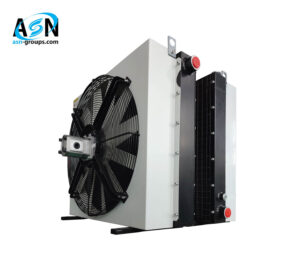
An air-cooled hydraulic oil heat exchanger, often called a radiator, works by pumping hot hydraulic fluid through a series of tubes surrounded by thin fins that dramatically increase surface area. A fan—powered by an electric, hydraulic, or engine-driven motor—forces ambient air across these fins. The moving air absorbs heat from the fins and carries it away, cooling the fluid inside.
Key characteristics of air-cooled heat exchangers:
-
Lower initial cost compared to water-cooled alternatives
-
Self-contained—no external water supply or cooling tower required
-
Simpler installation—only requires mounting and electrical connections
-
Ideal for mobile equipment (excavators, loaders, agricultural machinery)
-
Performance depends on ambient air temperature; efficiency declines on hot days.s
Within the air-cooled category, two subtypes exist:
-
Tube-fin oil coolers – Use round tubes with external fins. Hot fluid flows through the tubes, transferring heat to the tube walls and then to the fins, which are cooled by forced air. These offer moderate heat dissipation per unit volume.
-
Plate-fin oil coolers – Use rectangular tubes fabricated by brazing aluminum alloy plates. Internal turbulators create fluid turbulence, enhancing heat transfer. These provide higher heat dissipation per unit volume and are more compact and lightweight.
Water-Cooled Hydraulic Oil Heat Exchanger
A water-cooled hydraulic oil heat exchanger, most commonly a shell-and-tube or brazed plate design, uses water as the cooling medium. Hot oil flows through a bundle of tubes contained within a larger shell. Cool water circulates through the shell, flowing over the outside of the tubes, absorbing heat from the oil through the tube walls.
Key characteristics of water-cooled heat exchangers:
-
Significantly higher thermal efficiency—water’s thermal capacity is far greater than air’s
-
Performance independent of ambient air temperature
-
More compact for equivalent cooling capacity
-
Suitable for stationary industrial machinery with access to cooling water
-
Higher initial cost and requires water supply infrastructure (cooling tower, chiller, or municipal supply)
Direct Comparison – Air-Cooled vs. Water-Cooled
| Caratteristica | Air-Cooled Heat Exchanger | Water-Cooled Heat Exchanger |
|---|---|---|
| Cooling medium | Ambient air | Water |
| Thermal efficiency | Moderato | High (water has higher thermal capacity) |
| Initial cost | Lower | Higher |
| Installation complexity | Simple (mounting + electrical) | Complex (water supply + plumbing) |
| Operating environment dependency | Performance drops in high ambient temperatures | Independent of ambient temperature |
| Manutenzione | Clean fins, check fan operation | Monitor water quality, prevent scaling |
| Best suited for | Mobile equipment, remote sites, small industrial systems | Stationary industrial systems, high heat loads, high-duty cycles |
An adequately designed heat exchanger, whether air-cooled or water-cooled, is capable of removing the required amount of heat. The decision is rarely about which is “better” but rather which fits the specific application. Water-cooled units are more expensive but handle more demanding applications, while air-cooled units are gaining ground as more economical and efficient for many use cases.
Hydraulic Oil Heat Exchanger Performance and Sizing
Selecting the correct hydraulic oil heat exchanger requires calculating the actual heat load that must be dissipated. Undersizing leads to persistent overheating; oversizing wastes capital and energy.
Calculating Required Thermal Performance
The key performance metric for a hydraulic oil heat exchanger is the specific heat rejection (Qsp), expressed in kW/°C or kcal/h°C. The fundamental calculation follows this approach:
-
Step 1 – Determine the power to dissipate (Q) – This is the amount of heat generated by the system, typically expressed in kilowatts (kW). Heat generation can be measured directly or estimated from system inefficiencies.
-
Step 2 – Measure the temperature difference (ΔT) – Calculate the difference between the oil inlet temperature and the cooling medium temperature (ambient air for air-cooled; inlet water for water-cooled).
-
Step 3 – Calculate Qsp – Divide the power to dissipate by the temperature difference.
For example, if a system requires dissipation of 9 kW of heat, with an oil inlet temperature of 60°C and an ambient temperature of 30°C, the temperature difference is 30°C. The required specific exchange power is 9 kW ÷ 30°C = 0.30 kW/°C. The oil flow rate (recorded in liters per minute) and the calculated Qsp are then matched to the manufacturer’s performance curves to select the appropriate model.
Pressure Drop Considerations
Pressure drop across the heat exchanger is an equally important performance parameter. Every cooling element introduces resistance to oil flow, which adds to the system’s heat load. Pressure drop curves are typically based on a reference viscosity such as 30 cSt. When operating at higher viscosities, conversion factors must be applied to calculate the actual pressure drop.
Performance Expectations
Modern air-cooled hydraulic oil heat exchangers with advanced designs—such as aluminum alloy cores manufactured using vacuum brazing—achieve high heat exchange capacity in compact form factors. Features such as internal turbulators and optimized fin geometries further improve the total transmission coefficient, enabling smaller, lighter, and more robust products.
Hydraulic Oil Heat Exchanger Installation Best Practices
Proper installation of a hydraulic oil heat exchanger ensures maximum cooling efficiency and prevents premature failure.
-
Airflow clearance – For air-cooled units, install the exchanger with no obstacles to airflow. Maintain a minimum distance from walls equal to half the fan diameter to ensure natural flow of cooling air.
-
Mounting position – The cooler can be fitted in vertical or horizontal positions, but must be protected from impact and mechanical vibrations using flexible supports and vibration-dampening mounts.
-
Flexible connections – Use flexible tubing for both oil and water service connections. This absorbs vibration and prevents stress on fittings and the core.
-
By-pass valve installation – Install a by-pass valve to prevent damage caused by pressure spikes, flow hammering, and pulsations, particularly during cold starts when oil is thick.
-
Placement in circuit – The cooler should not be placed directly in front of the return oil filter, as this restricts flow and creates unnecessary backpressure. The heat dissipation area must be sufficient for the expected heat load, and the flow capacity must not be too low for the system’s peak oil flow rate.
Hydraulic Oil Heat Exchanger Maintenance and Troubleshooting
Even the best hydraulic oil heat exchanger requires regular maintenance to sustain performance.
Common Failure Symptoms
-
Reduced system performance – Sluggish equipment operation, decreased power output, or difficulty controlling hydraulic functions indicate potential cooling problems.
-
High oil temperature readings – Persistently high temperature gauge readings exceeding manufacturer recommendations suggest insufficient cooling.
-
Unusual noises – Grinding or whining from pumps or components may indicate overheating and internal damage.
-
Visible leaks – Leaks around fittings, hoses, or the cooler core reduce cooling efficiency and should be addressed promptly.
Cleaning Procedures
-
Air side (air-cooled units) – Use compressed air to blow out loose dirt and debris, directing the air jet parallel to the fins to prevent damage. For oil or grease buildup, use a jet of steam or hot water. Protect the electric motor during all cleaning procedures.
-
Oil side – After disassembling the exchanger, circulate a degreasing substance compatible with the core material. Flush with hydraulic oil before reconnecting the cooler.
Leak Repair
-
Minor fin damage may be repairable with specialized epoxy or soldering techniques.
-
Fitting leaks require tightening or seal replacement.
-
Core leaks are typically not repairable, and the cooler must be replaced.
Regular oil analysis detects early signs of wear and contamination, providing preventive maintenance data before catastrophic failure occurs.
Hydraulic Oil Heat Exchanger Selection Guide
When selecting a hydraulic oil heat exchanger for your cooling system, consider these factors in order:
-
Calculate total heat load (kW) – Measure or estimate all heat generated by inefficiencies in pumps, valves, and actuators.
-
Determine available cooling medium – Is ambient air suitable, or is water available from a cooling tower or municipal supply?
-
Assess operating environment – High ambient temperatures favor water-cooled designs; remote or mobile applications favor air-cooled.
-
Consider installation space – Plate-fin air-cooled units are more compact than tube-fin designs for equivalent cooling capacity.
-
Check pressure drop constraints – Ensure the selected exchanger’s pressure drop does not exceed system allowances.
-
Verify material compatibility – Aluminum alloy cores offer excellent thermal conductivity and corrosion resistance; stainless steel is required for aggressive environments.
Market Context – Growing Demand for Hydraulic Cooling Solutions
As industrial automation expands and hydraulic systems operate under higher power densities, the demand for efficient heat exchangers continues to grow. Advanced manufacturing techniques, such as vacuum brazing of aluminum cores, have enabled more compact, lightweight, and technologically advanced cooling products that provide superior heat transfer in smaller footprints. These innovations allow system designers to meet cooling requirements without sacrificing valuable machine space.
FAQ
Q1: What temperature should a hydraulic oil heat exchanger maintain?
A hydraulic oil heat exchanger should keep oil within the optimal range of 49–60°C (120–140°F). Above 82°C (180°F), hydraulic oil degrades rapidly, losing viscosity and lubrication performance.
Q2: How can I tell if my hydraulic oil heat exchanger is undersized?
An undersized hydraulic oil heat exchanger cannot remove heat efficiently. Common signs include:
- Persistently high oil temperatures under normal load
- Stable operating temperature above 82°C
- Frequent temperature alarms
Q3: What is the difference between air-cooled and water-cooled hydraulic oil heat exchangers?
Air-cooled hydraulic oil heat exchangers use ambient air and a fan, making them simpler and more suitable for mobile equipment.
Water-cooled hydraulic oil heat exchangers use circulating water, offering higher efficiency and stable cooling for high-load industrial systems.
Q4: How often should I clean a hydraulic oil heat exchanger?
A hydraulic oil heat exchanger should be cleaned:
- Every 3–6 months in normal environments
- Monthly in dusty or harsh conditions
Immediate cleaning is required if debris buildup or rising oil temperatures are observed.
Q5: Do I need a bypass valve for a hydraulic oil heat exchanger?
Yes. A bypass valve protects a hydraulic oil heat exchanger from:
- Pressure spikes
- Flow hammering
- Cold-start high viscosity conditions
It is strongly recommended for most hydraulic systems.
Conclusione
A hydraulic oil heat exchanger is not an optional accessory in modern hydraulic systems—it is essential for maintaining reliability and extending equipment life. By controlling excessive heat, it helps protect hydraulic oil from thermal degradation, reduces wear on critical components, and ensures stable system performance under continuous operation. It also improves energy efficiency by maintaining optimal fluid viscosity, which directly supports smoother pump operation and more consistent pressure output in demanding industrial environments.
Overheating remains one of the most critical challenges in hydraulic systems, directly impacting efficiency, reliability, and service life. A properly selected scambiatore di calore per olio idraulico is key to maintaining stable operating temperatures and preventing premature system failure.
For technical support, customization, or product inquiries, please contattateci.