


Introduction
Hydraulic systems are the workhorses of industrial and mobile equipment, but they face a silent enemy: excess heat. When hydraulic oil exceeds its optimal temperature range, viscosity breaks down, seals harden, pumps lose efficiency, and unplanned downtime skyrockets. For procurement managers and maintenance engineers, selecting the right cooling solution is not just a technical detail—it is a direct driver of operational ROI.
Among all available technologies, aluminium core heat exchangers have emerged as the preferred choice for demanding hydraulic oil cooling applications. Combining superior thermal conductivity, lightweight construction, and excellent corrosion resistance, they deliver measurable improvements in system reliability, energy consumption, and component lifespan.
This article provides a data‑driven analysis of aluminium core heat exchangers, covering thermal management fundamentals, design advantages, performance impacts, and real‑world application scenarios. By the end, you will understand why aluminium core heat exchangers are the benchmark for hydraulic thermal management and how to select the optimal unit for your specific needs.
Fundamentals of Hydraulic Oil Thermal Management
Why Temperature Control is Critical in Hydraulic Systems
Hydraulic fluid temperature directly governs system performance, component longevity, and operational safety. When hydraulic oil exceeds its optimal thermal range (typically 40‑60°C), viscosity degradation accelerates exponentially. According to ISO 4406 contamination control standards, every 10°C increase above 60°C halves the oxidation stability of mineral‑based hydraulic oils, generating acidic compounds that corrode internal surfaces and accelerate seal deterioration.
Elevated temperatures compromise the fluid’s load‑bearing capacity, reducing the hydrodynamic film thickness between moving parts. This phenomenon increases metal‑to‑metal contact in pumps and actuators, generating wear particles that contaminate the system and trigger cascading failures. Elastomeric seals experience accelerated hardening at sustained temperatures above 80°C, leading to leakage and catastrophic pressure loss. Field data from industrial hydraulic presses indicates that maintaining oil temperature within specification reduces unplanned downtime by 35‑40% compared to systems operating with inadequate thermal management. Aluminium core heat exchangers are specifically designed to prevent such temperature excursions.
The viscosity‑temperature relationship follows the Walther equation, where a 20°C temperature swing can alter kinematic viscosity by 40‑60% in ISO VG 46 fluids. This variability impacts volumetric efficiency in gear pumps (typically rated at 90‑95% efficiency at design temperature) and creates unpredictable actuator response times in precision control applications. Installing aluminium core heat exchangers stabilizes this critical parameter.
Heat Generation Sources in Hydraulic Operations
Hydraulic systems convert mechanical energy into fluid power with inherent thermodynamic losses. The primary heat sources include:
-
Pump Inefficiencies: Volumetric and mechanical losses in hydraulic pumps account for 15‑25% of input power, manifesting as heat. A 75 kW variable displacement piston pump operating at 85% overall efficiency dissipates approximately 11 kW as thermal energy into the hydraulic fluid.
-
Valve Throttling Losses: Proportional and servo valves regulate flow through controlled pressure drops, converting hydraulic energy to heat. A directional control valve managing 100 L/min at 50 bar pressure drop generates 8.3 kW of thermal load—equivalent to the heat output of a small industrial heater.
-
Cylinder Work Cycles: Friction between piston seals and cylinder bores, combined with fluid compression heating, contributes 5‑10°C temperature rise per complete extension‑retraction cycle in high‑duty applications like injection molding machines.
-
Fluid Shear Heating: High‑velocity flow through restrictive passages (orifices, filters, hoses) subjects oil molecules to shear stress, particularly relevant in systems exceeding 3 m/s fluid velocity.
Typical mobile hydraulic excavators experience ambient‑to‑operating temperature differentials of 25‑35°C during continuous duty cycles, while stationary industrial presses may see 15‑20°C rises under moderate loading. Without active cooling, these systems would reach thermal equilibrium at temperatures exceeding safe operational limits within 45‑90 minutes of startup. This is precisely where aluminium core heat exchangers prove indispensable.
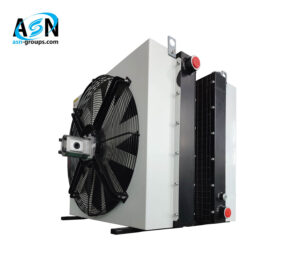
Aluminium Core Heat Exchanger Design Advantages
Superior Thermal Conductivity vs. Traditional Materials
Aluminium’s thermal conductivity of 205 W/m·K positions it as the optimal material for compact heat exchanger designs, offering 3.5× the heat transfer efficiency of stainless steel (16 W/m·K) and 50% of copper’s conductivity at 30% of the material cost. This property enables thinner fin geometries while maintaining structural integrity under pressure cycling. Aluminium core heat exchangers leverage this advantage to achieve unmatched cooling density.
In oil‑to‑air heat exchangers, fin density directly correlates with surface area and heat dissipation capacity. Aluminium core heat exchangers support fin spacings of 1.5‑2.5 mm (10‑17 fins per inch) compared to 3‑4 mm for steel constructions, increasing effective heat transfer area by 40‑60% within identical envelope dimensions. The thermal resistance equation (R = L/kA) demonstrates that doubling fin density while maintaining 0.5 mm fin thickness reduces overall thermal resistance by 35%, translating to proportional improvements in cooling capacity.
Brazed aluminium plate‑fin designs achieve heat transfer coefficients of 800‑1200 W/m²·K in hydraulic oil applications, compared to 400‑600 W/m²·K for conventional tube‑and‑fin copper constructions. This performance advantage allows aluminium core heat exchangers to deliver equivalent cooling capacity in 60‑70% of the physical volume required by alternative materials.
Lightweight Construction and Corrosion Resistance
Aluminium’s density of 2.7 g/cm³ delivers weight reductions of 60‑65% compared to copper (8.96 g/cm³) and 70% versus steel (7.85 g/cm³). For mobile hydraulic applications—construction equipment, agricultural machinery, material handlers—this translates to payload capacity gains and reduced fuel consumption. A typical 15 kW aluminium oil cooler weighs 8‑12 kg versus 25‑30 kg for an equivalent copper‑brass unit. This weight saving is a hallmark of well‑engineered aluminium core heat exchangers.
The material’s natural oxide layer (Al₂O₃) provides inherent corrosion protection, but industrial hydraulic environments demand enhanced durability. Anodized surface treatments per ASTM B209 specifications create controlled oxide layers of 5‑25 microns thickness, offering:
-
Chemical Resistance: Compatibility with mineral oils, phosphate esters, and water‑glycol fluids without galvanic corrosion
-
Abrasion Protection: Surface hardness of 200‑400 HV, resisting particulate contamination damage
-
Thermal Stability: Oxide layer integrity maintained across -40°C to +150°C operational range
Chromate conversion coatings (MIL‑DTL‑5541) provide additional protection in marine or high‑humidity environments where chloride exposure accelerates pitting corrosion. Properly treated aluminium core heat exchangers demonstrate 15‑20 year service lives in industrial hydraulic systems with biannual maintenance intervals.
Material Comparison Matrix
| Property | Aluminium Alloy | Copper‑Brass | Stainless Steel | Cast Iron |
|---|---|---|---|---|
| Thermal Conductivity (W/m·K) | 205 | 385 | 16 | 52 |
| Density (g/cm³) | 2.7 | 8.9 | 7.9 | 7.2 |
| Corrosion Resistance (Untreated) | Good | Moderate | Excellent | Poor |
| Relative Cost Index | 1.0 | 3.2 | 2.8 | 0.8 |
| Typical Service Life (Years) | 15‑20 | 20‑25 | 25‑30 | 10‑15 |
| Pressure Rating Capability (Bar) | 16‑25 | 25‑40 | 40‑100 | 10‑16 |
When selecting aluminium core heat exchangers, always verify that the alloy and surface treatment match your specific hydraulic fluid and operating environment.
Performance Impact on Hydraulic System Efficiency
Maintaining Optimal Oil Viscosity Range
Hydraulic pump efficiency exhibits strong temperature dependence through the viscosity‑performance relationship. Gear pumps operating with ISO VG 46 oil at 40°C achieve 92‑94% volumetric efficiency, degrading to 85‑88% at 70°C due to increased internal leakage across clearances. Conversely, cold‑start conditions at 10°C elevate viscosity to levels causing mechanical efficiency losses of 8‑12% from increased churning resistance.
Aluminium core heat exchangers stabilize bulk oil temperature within ±5°C of the design setpoint (typically 50°C), maintaining viscosity in the 25‑35 cSt range optimal for most industrial hydraulic fluids. This thermal stability delivers measurable energy savings:
-
Pump Power Reduction: Maintaining 50°C versus uncontrolled 75°C operation reduces input power requirements by 7‑11% in variable displacement pumps
-
Actuator Response Improvement: Consistent viscosity ensures predictable valve flow coefficients, reducing positioning errors in servo‑controlled systems by 15‑20%
-
Filtration Efficiency: Stable temperature prevents thermal expansion of filter media, maintaining beta ratios and reducing bypass valve activation frequency
Field measurements from a 200‑ton hydraulic press installation showed that retrofitting aluminium core heat exchangers reduced monthly energy consumption by 840 kWh (9% reduction) while improving cycle time consistency by 12%. The payback period for the cooling system investment was 14 months based solely on energy savings, excluding maintenance cost reductions.
Extended Component Service Life
The Arrhenius equation governing chemical reaction rates demonstrates that every 10°C reduction in operating temperature doubles the oxidation stability of hydraulic fluids. Practical implications include:
-
Fluid Replacement Intervals: Systems maintaining 50°C average oil temperature achieve 4000‑5000 hour fluid life versus 2000‑2500 hours at 70°C, reducing annual fluid replacement costs by 40‑50% in continuous‑duty applications.
-
Seal Longevity: Nitrile (NBR) and polyurethane seals exhibit exponential degradation curves above 60°C. Temperature control extends the mean time between seal failures from 8000 hours to 15000+ hours, particularly critical in high‑cycle‑count actuators.
-
Pump Bearing Life: The L10 bearing life equation (L10 ∝ (C/P)³) incorporates temperature‑dependent lubricant film thickness. Maintaining optimal oil viscosity through thermal management extends pump bearing life by 60‑80%, as validated by accelerated life testing per ISO 281.
-
Valve Spool Wear: Reduced thermal cycling minimizes clearance growth in precision valve spools, maintaining flow gain characteristics throughout 20000+ hour service intervals versus 12000 hours in thermally uncontrolled systems.
Maintenance records from a fleet of 47 mobile hydraulic excavators demonstrated that units equipped with properly sized aluminium core heat exchangers required major hydraulic component overhauls at 9500‑hour intervals versus 6200 hours for units relying solely on reservoir cooling—a 53% improvement in component durability.
Application Scenarios and Selection Criteria
Industrial vs. Mobile Hydraulic Systems
Stationary Industrial Applications (presses, injection molding, test stands) benefit from:
-
Forced‑Air Cooling: Aluminium core heat exchangers with 400‑800 CFM axial fans achieve 15‑25 kW heat dissipation in compact footprints
-
Liquid Cooling Integration: Brazed plate designs connect to facility water loops (10‑15°C supply temperature) for 30‑50 kW capacities
-
Acoustic Optimization: Low‑speed fans (1200‑1800 RPM) maintain <65 dBA noise levels in manufacturing environments
Specification priorities include maximum heat rejection capacity, minimal pressure drop (<0.5 bar at design flow), and integration with PLC‑controlled temperature management systems.
Mobile Hydraulic Systems (excavators, loaders, agricultural equipment) require:
-
Vibration Resistance: Brazed aluminium construction withstands 5‑8G shock loads per ISO 6954 testing protocols
-
Airflow Optimization: Radiator‑style cores positioned for ram‑air cooling at vehicle speeds, supplemented by hydraulically‑driven fans
-
Compact Packaging: Aluminium core heat exchangers integrate into chassis structures with <15 kg weight penalties
Critical selection factors include mounting flexibility, resistance to environmental contamination (dust, mud, debris), and compatibility with machine hydraulic/cooling circuits.
Key Specification Parameters for Procurement
When sourcing aluminium core heat exchangers, evaluate the following parameters:
Heat Dissipation Capacity – Calculated using Q = ṁ × Cp × ΔT, where:
-
ṁ = hydraulic fluid mass flow rate (kg/s)
-
Cp = specific heat capacity (1.9‑2.1 kJ/kg·K for mineral oils)
-
ΔT = target temperature reduction (typically 10‑20°C)
Example: A system circulating 60 L/min (0.87 kg/s) requiring 15°C cooling demands Q = 0.87 × 2.0 × 15 = 26.1 kW heat exchanger capacity.
Pressure Rating – Must exceed maximum system pressure by a 25‑40% safety margin. Common ratings:
-
Low‑pressure circuits: 10‑16 bar
-
Medium‑duty industrial: 16‑25 bar
-
High‑performance mobile: 25‑35 bar
Port Configuration – NPT, BSPP, or SAE flange connections sized to maintain fluid velocity <2.5 m/s, preventing erosion and cavitation. Standard port sizes range from 3/4″ to 2″, depending on flow rates.
Airflow/Coolant Requirements – Oil‑to‑air units specify CFM requirements (300‑1200 CFM typical); liquid‑cooled designs require coolant flow rates of 5‑15 L/min at specified inlet temperatures.
Dimensional Constraints – Core dimensions, mounting hole patterns, and clearance requirements for retrofits versus new installations.
FAQ
Q1: What temperature range should hydraulic oil be maintained at for optimal performance?
Industrial hydraulic systems achieve optimal performance with bulk oil temperatures between 40‑60°C (104‑140°F). This range maintains ISO VG 46 fluid viscosity at 25‑35 cSt, ensuring proper lubrication film thickness while preventing thermal degradation. The maximum safe operating temperature is typically 80°C, though continuous operation above 70°C accelerates oxidation and seal wear. Mobile equipment in extreme climates may operate at 60‑70°C but requires synthetic fluids with enhanced thermal stability. Properly sized aluminium core heat exchangers keep your system safely within this window.
Q2: How do aluminium core heat exchangers compare to plate‑and‑frame designs in terms of maintenance?
Aluminium core heat exchangers require minimal maintenance—annual external cleaning and biannual pressure testing—due to their sealed construction and corrosion‑resistant surfaces. Plate‑and‑frame designs offer serviceability advantages (individual plate replacement, mechanical cleaning access) but demand quarterly gasket inspections and more frequent disassembly for fouling removal. For hydraulic oil applications with proper filtration (ISO 18/16/13 cleanliness), aluminium core heat exchangers provide 15‑20 year service lives with lower total cost of ownership despite being non‑serviceable.
Q3: Are aluminium core heat exchangers compatible with synthetic hydraulic fluids?
Yes, anodized aluminium core heat exchangers demonstrate full compatibility with major synthetic hydraulic fluid classes including phosphate esters (HFD‑R), polyol esters (HFD‑U), polyalphaolefins (PAO), and water‑glycol formulations (HFC). The protective oxide layer resists chemical attack from ester‑based fluids that corrode untreated aluminium. However, procurement specifications should verify: anodizing thickness ≥10 microns per ASTM B209, brazing alloy compatibility (avoid zinc‑containing fillers with phosphate esters), and gasket/seal materials rated for specific fluid chemistry. Always consult manufacturer compatibility charts for exotic fluids.
Q4: How do I correctly size an aluminium core heat exchanger for my hydraulic system?
Sizing requires calculating the total heat load (Q = ṁ × Cp × ΔT), measuring maximum allowable pressure drop, and determining available airflow or coolant flow. For mobile applications, account for average vehicle speed (ram air effect). For industrial systems, consider ambient temperature extremes. Most suppliers offer free sizing software; however, a safe rule is to add a 15‑20% safety margin to the calculated heat load. Oversized aluminium core heat exchangers cause minimal harm (slightly higher cost), but undersized units lead to chronic overheating and premature system failure.
Q5: What is the typical lifespan of aluminium core heat exchangers in industrial environments?
With proper surface treatment (anodizing or chromate conversion) and regular cleaning, aluminium core heat exchangers last 15‑20 years in typical industrial hydraulic systems. Factors that reduce lifespan include: operation in high‑chloride environments (coastal or chemical plants), use of incompatible fluids, frequent thermal shock cycles, and neglected external fin cleaning. Periodic non‑destructive testing (pressure decay, thermal imaging) can detect early degradation. Compared to copper‑brass units (20‑25 years), aluminium offers a slightly shorter but still excellent service life at significantly lower initial cost and weight.
Wnioski
Aluminium core heat exchangers represent the optimal thermal management solution for modern hydraulic systems, delivering superior heat dissipation performance through high thermal conductivity, compact lightweight construction, and corrosion‑resistant durability. By maintaining hydraulic oil within the critical 40‑60°C operational window, these cooling systems prevent viscosity‑related efficiency losses, extend component service life by 50‑80%, and reduce energy consumption by 7‑11% compared to thermally uncontrolled installations.
The material advantages of aluminium—205 W/m·K thermal conductivity, 60‑70% weight reduction versus traditional materials, and 15‑20 year service life with proper surface treatment—align directly with industrial procurement priorities of performance, reliability, and total cost of ownership. Selection criteria should prioritize heat dissipation capacity matched to system thermal load calculations, pressure ratings exceeding maximum operating conditions by 25‑40%, and mounting configurations compatible with space constraints. Investing in high‑quality aluminium core heat exchangers is one of the most effective ways to boost hydraulic system uptime.
For procurement managers evaluating hydraulic cooling solutions, aluminium core heat exchangers offer measurable ROI through reduced maintenance intervals, extended fluid replacement cycles, and improved system uptime. Compliance with ASTM B209 material standards and ISO 4406 cleanliness requirements ensures compatibility with modern hydraulic system designs while meeting increasingly stringent operational efficiency mandates. The technology’s proven performance across industrial manufacturing, mobile equipment, and precision control applications establishes it as the benchmark for hydraulic thermal management in demanding operational environments.